
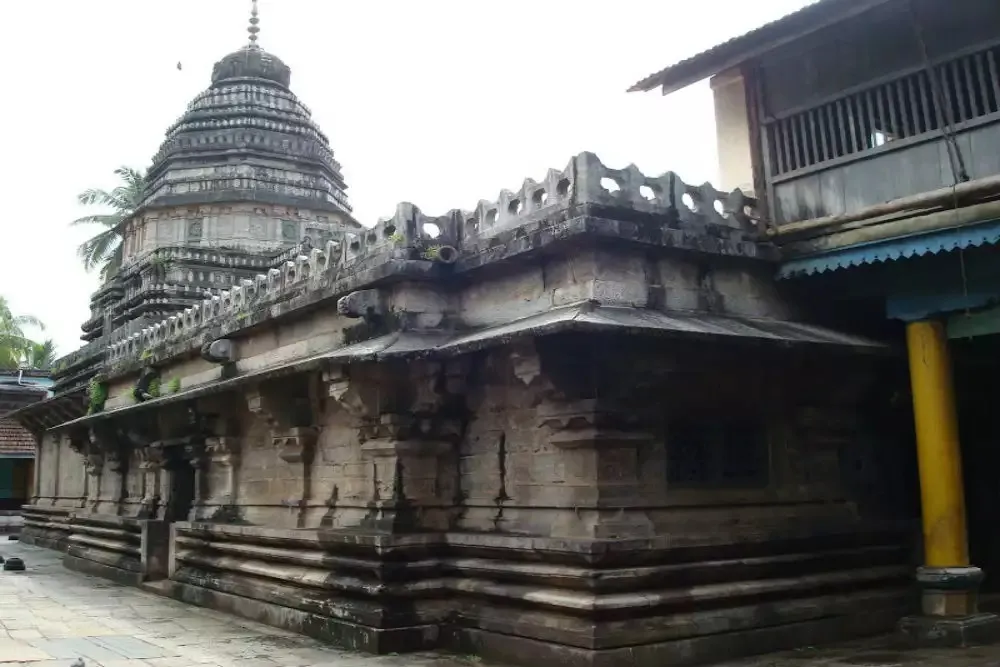
Shree Mahabaleshwar Temple is the temple pilgrims come to Gokarna for. It stands in the old temple street, in Uttara Kannada district on the Karnataka coast, and it enshrines what devotees hold to be the Atmalinga — the linga Lord Shiva is said to have given away as his own self, and which never moved again once it was set down on this shore. That one event is why Gokarna is a teertha kshetra, why the deity is called Mahabaleshwara, the lord of great strength, and why families travel here to perform pitru karya for their departed.
Below: what the Atmalinga is, the Ravana and Ganesha legend behind it, what to expect at darshan, and which poojas and pujas are performed here. If you already know which ritual you need, go to our pooja services at Gokarna; for the town and its teerthas, see our guide to Gokarna Kshetra and its sacred geography.
Where is the Gokarna Mahabaleshwar Temple?
Gokarna is a temple town in Uttara Kannada district, Karnataka, on the Arabian Sea coast near the estuary of the river Aghanashini. The Mahabaleshwar Temple sits at the centre of it, with Koti Teertha, the sacred temple tank, close by and the shore at Gokarna beach within easy walking distance — which is why snana, tarpana and immersion rites can all be completed in the same morning as the temple ceremony.
Two confusions are worth settling before you book travel. Gokarna in Karnataka is not Gokarna in Nepal, and the Mahabaleshwar of this Atmalinga is not the hill station named Mahabaleshwar in Maharashtra. If the Atmalinga is what you are looking for, the address you want is Gokarna, Uttara Kannada, Karnataka 581326.
What is the Atmalinga at Gokarna?
An atma linga is not simply one more Shiva linga. The word means the linga of the self: in the sthala purana it is Shiva's own being, given away rather than installed by human hands, and it is therefore held to carry the presence of the deity without the usual rites of consecration. Worship offered here is traditionally said to carry the merit of long penance performed elsewhere — that claim, not the building, is what has drawn pilgrims to this coast for centuries.
The Atmalinga is worshipped at Gokarna as Lord Mahabaleshwara. Devotees also call the place Bhookailasa, Kailasa upon the earth, because the linga that belonged on Mount Kailasa came to rest here instead. Abhisheka, bilva leaves and the daily temple pooja are offered to it, and it is the presence of this linga that makes the site a kshetra rather than a shrine.
The Atmalinga story: Ravana, Lord Ganesha and how Gokarna got its name
The legend is told in the sthala purana of Gokarna, and it explains almost everything else on this page.
Ravana, the king of Lanka, performed severe penance to Lord Shiva and asked for the Atmalinga, so that his kingdom would be beyond defeat. Shiva granted it, on one condition: the linga must not be set down on the earth anywhere along the journey, for wherever it touched the ground it would remain fixed for ever.
The devas, alarmed at what an undefeatable Lanka would mean, appealed to Lord Vishnu — and the plan that followed turned on Ravana's own discipline. As he reached this coast, dusk was made to fall, and Ravana, who never neglected his sandhya vandana, had to put the linga into someone's hands to perform his evening prayers. Lord Ganesha appeared before him as a young brahmin boy. Ravana asked the boy to hold the Atmalinga; the boy agreed on a condition of his own — he would call out three times, and if Ravana had not returned by the third call, he would set it down. He called three times, and set the Atmalinga on the ground.
Ravana returned and pulled at it with all his strength, and it did not move. It is because even that great strength could not shift it that the deity here is Mahabaleshwara. In the telling, the linga was twisted out of shape by the attempt and took the form of a cow's ear — go-karna — which is one account of how the town received its name; another holds that Shiva emerged here from the ear of the earth in the form of a cow. The fragments Ravana flung away in his fury are said to have fallen at the places now revered as Sajjeshwara, Guneshwara, Murudeshwara and Dhareshwara, which together with Gokarna are visited as a group of kshetras to this day.
Call +91 83109 37047 (Vishu Guruling) for all Gokarna pooja details
WhatsApp UsWhy is Gokarna called Dakshina Kashi and a mukti kshetra?
The epithets tell you what the place is for. Dakshina Kashi — the Kashi of the south — sets Gokarna beside Varanasi as a site where the last rites and the offerings made to ancestors are held to carry particular weight; Bhookailasa names it Kailasa upon the earth; mukti kshetra names its purpose, the release of the departed from the cycle of birth and death. That is why the poojas performed here are overwhelmingly for the dead rather than for the living, and why devotees perform them seeking peace and gati for their ancestors rather than any worldly result. Our longer piece on why Gokarna is called Dakshina Kashi takes up the seven mukti kshetras, Rudrapada and the teerthas of the town.
Which poojas and sevas are performed at the Mahabaleshwar Temple?
Two quite different things are called a pooja at Gokarna, and it saves confusion to know which you are asking about.
The first is the temple's own seva — abhisheka, rudrabhisheka, mahapooja, tailabhisheka and the other offerings made to Lord Mahabaleshwara. Those are arranged through the temple itself, and what is available on a given day, and on what terms, is the temple administration's to decide. Our Gokarna pooja list describes the sevas devotees usually ask for and which puja suits which need.
The second is pitru karya — the ancestral rites performed by a purohit in the kshetra, in your gotra and in the names of your departed. These are the rituals we conduct, under Vishweshwar D. Bhat Gurulingaji, Kshetra Gokarna Purohit: the combined Narayan Nagbali puja at Gokarna, Moksha Narayana Bali, Tripindi Shraddha (Tripindi shradh), Naga Bali or nagabali, pind daan and tarpan at Koti Teertha, asthi visarjan, and the pitru dosha nivarana and parihara rites performed when an astrologer has read pitra dosh in a horoscope.
Poojas performed in the Gokarna kshetra
Why is Gokarna chosen for pitru karya and ancestral pujas?
The reason is the Atmalinga itself: an ancestral offering made in the presence of Shiva's own linga, in a kshetra named for mukti, is traditionally held to carry the fullest effect the shastras describe for that rite. The practical reasons matter too — everything a pitru karya needs lies within a few minutes of the temple, from the teertha for snana and tarpana to the ghats where pinda daan is offered and the sea for asthi visarjan, and the purohits here perform these rituals as daily work rather than occasionally.
Families come after an untimely or unnatural death, when a shraddha or shradh has been left undone for years, when an astrologer has read pitru dosha or pitra dosh, when sarpa dosha or naga dosha appears in a horoscope, and above all during the sixteen days of Pitru Paksha, when Gokarna is at its busiest.
What are the Gokarna Mahabaleshwar Temple darshan timings?
This is the most-searched question about the temple, and the honest answer is that we will not print a timetable. Darshan hours are set by the temple administration and changed on festival days, on Mahashivaratri, during Kartika month and Pitru Paksha, and whenever the crowd requires it — a schedule copied onto a website in one year is wrong by the next.
What we can do is tell you the hours in force for your date: call +91 83109 37047 or +91 88613 21496 a day or two before you travel. The same applies to entry arrangements, queues and any charge the temple makes for a seva — those are the temple's to set, and we quote none of them.
Can devotees touch the Atmalinga during darshan?
Gokarna is known among devotees for sparsha darshan — darshan in which the linga may be touched — which is unusual at Shiva kshetras, where the linga is normally approached only by the archakas. It is a large part of why pilgrims want to come here.
Whether it is being permitted on your date, at which hour, and on what conditions, is entirely for the temple administration to decide, and it varies with the day and the crowd. Ask at the temple when you arrive, or ask us when you call, so that you plan your morning around what is actually possible.
What is the dress code, and are phones and cameras allowed?
Dress traditionally and modestly: dhoti or veshti for men, saree or salwar for women. Footwear and leather articles are left outside. Beyond that, entry rules — including what may be carried in and whether phones and cameras are permitted near the sanctum — are enforced by the temple staff at the door and are tightened on busy days, so assume the stricter case and plan somewhere to leave your belongings.
If you are performing a ritual rather than only taking darshan, the requirements are more specific: what to wear, what to bring, when to fast, and whether darshan is taken before or after the ceremony. Those are settled with you when the pooja is booked. Photographing a ritual in progress is a matter of courtesy — ask the purohit first.
How to plan a visit and arrange a pooja at Gokarna Mahabaleshwar Temple
Plan the visit around the ritual, not around the darshan queue. Most ancestral poojas at Gokarna begin early and run for a few hours; a combined rite such as Narayan Nagbali runs across two to three days, so families are usually advised to keep a night or two free.
To arrange one, call +91 83109 37047 or +91 88613 21496 and have ready the ritual you intend to perform, the names and gotra of the departed, your relationship to them and your dates. You will be told the auspicious day, what the vidhi involves, how many days to keep free and what to bring. We publish no figure for dakshina, because it varies with the scale of the rite and the size of the family — our page on how pooja cost at Gokarna is worked out explains what determines it and what is included, and one amount is quoted to you on the call. If you cannot travel at all, online pooja booking at Gokarna explains how the puja is performed here in your name.
Gokarna Mahabaleshwar Temple at a glance
- Deity
- Lord Mahabaleshwara — Shiva worshipped in the form of the Atmalinga
- Also known as
- Gokarna Mahabaleshwar Temple, Mahabaleshwara Temple, Atmalinga temple
- Where it is
- Gokarna, Uttara Kannada District, Karnataka 581326, India
- Names of the kshetra
- Dakshina Kashi, Bhookailasa, Mukti Kshetra
- Best known for
- Atmalinga darshan, and pitru karya — shraddha, tarpana, pind daan and nagbali puja
- Darshan timings
- Set by the temple administration and changed on festival days — confirm before you travel
- Poojas we arrange
- Narayan Nagbali, Moksha Narayana Bali, Tripindi Shraddha, Naga Bali, Pind Daan, Asthi Visarjan
- Ask about a pooja
- +91 83109 37047 or +91 88613 21496
Gokarna Mahabaleshwar Temple — frequently asked questions
What are the Gokarna Mahabaleshwar Temple timings?
Is there an entry fee or a special darshan queue at Gokarna temple?
Can devotees touch the Atmalinga at Gokarna?
What is the dress code at the Gokarna temple?
Are mobile phones and cameras allowed inside the temple?
How much time does darshan take at Gokarna Mahabaleshwar Temple?
Which poojas can be booked at the Mahabaleshwar Temple?
Can Atmalinga darshan be booked online?
Is Gokarna in Karnataka the same as Mahabaleshwar in Maharashtra?
Perform a pooja at Shree Mahabaleshwar Temple, Gokarna
Speak to Vishweshwar D. Bhat Gurulingaji, Kshetra Gokarna Purohit, for auspicious dates, the vidhi procedure and complete arrangements for your visit.