
Naga Pratishta is the rite of consecrating a carved serpent stone — the naga kallu or naga vigraha — and installing it so that a family has a permanent seat of serpent worship. The same ritual is written Naga Pratishtha or Nag Pratishtha in North India, appears as Naga Prathista in older records, and is called Naga Pratishte in Kannada, which is the form used here in Gokarna and the reason this page carries that spelling. At the Mahabaleshwar Temple the puja runs over two days: Sarpa Samskara on the first, and the pratishtapana of the naga on the second.
Families travel here for this pooja because Gokarna — the temple town in Uttara Kannada district on the Karnataka coast, not the Gokarna near Kathmandu — is traditionally counted among the mukti kshetras and called Dakshina Kashi, the Kashi of the South. The Gokarna Mahabaleshwar Temple and its Atmalinga are why naga and pitru rites performed at this kshetra are held to carry particular weight, and why sarpa dosha parihara rites are sought at this kshetra rather than closer to home.
Also known as: Naga Pratishta · Naga Pratishtha · Sarpa Samskara · Sarpa Dosha Parihara
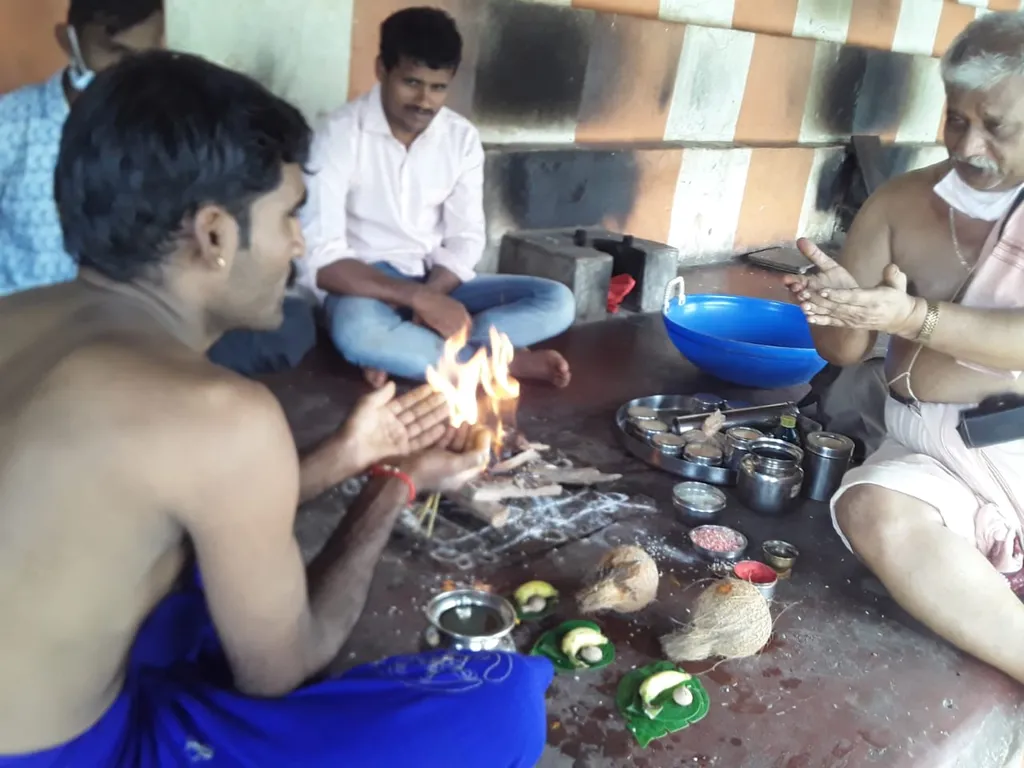
Naga Pratishta at a glance — duration, best days and who attends
- How long it takes
- 2 days
- Best days / tithis
- Panchami, Shravana month
- Who should perform it
- A family member of the lineage
- What we arrange
- Naga idol, pratishtapana samagri, priests
- Where it is performed
- Shree Mahabaleshwar Temple precincts, Gokarna, Karnataka
- Dakshina
- Varies with the scale of the rite — call +91 83109 37047 for a quote
What is Naga Pratishta (Naga Pratishte)?
Naga Pratishta is a pratishtapana — a consecration. A stone naga, usually a pair of serpents carved entwined on a single slab, is bathed, invoked and installed as a living presence through prana pratishtha and nyasa, accompanied by Vedic mantras. From that day the stone is not an ornament but a deity, and the family is expected to worship it.
The rite honours the Naga Devatas — Ananta, Vasuki, Takshaka and the other serpent deities who, in the shastras, are the guardians of the earth, of water and of fertility. Offerings of milk, turmeric, tender coconut, flowers and the prescribed herbal preparations are made to them, and the purohits follow the vidhi laid down in the agama and Vedic texts. Devotees traditionally hold that the ceremony cleanses serpent-related afflictions and places the household under the protection of the Nagas.
Why do families perform Naga Pratishta puja?
People rarely arrive at this pooja out of curiosity. Devotees come for one of a handful of reasons that recur throughout this tradition:
- A jyotishi or a prashna has identified sarpa dosha or naga dosha in the family — often read through Rahu and Ketu, and sometimes described as sarp dosh in Hindi-speaking homes.
- An ancestral naga bana, naga gudi or naga kallu on the family land has been neglected for a generation, or the stone has cracked, sunk or been lost.
- A serpent was killed knowingly or unknowingly by someone in the lineage, or an anthill was destroyed while clearing land or building a house.
- Repeated dreams of serpents, or an elder in the family instructing that the naga be re-established.
The circumstances behind those reasons tend to be much the same: a marriage that has been delayed year after year, difficulty in having children, recurring illness in the household, or ancestral land that has never prospered — and a jyotishi who has traced it back to sarpa dosha. The shastras treat such things as indications worth examining, not as diagnoses. The rite is performed as prayaschitta, in the spirit of settling an old debt, and the result is left to the Naga Devatas rather than promised by anyone.
Devotees perform this puja seeking relief from those doshas and the restoration of a naga sthana the family had let lapse. Where the horoscope points specifically at a Rahu-Ketu axis, the purohit may also recommend a Kaal Sarp Dosh Nivaran pooja alongside it — Kaal Sarpa Dosha and sarpa dosha are related but not the same thing.
What is Sarpa Samskara?
Sarpa Samskara is the expiatory rite performed for serpents harmed by the family, and it is the reason the Naga Pratishta at Gokarna is a two-day affair rather than a one-day one. The shastras hold that a serpent killed by a household must be given the same funerary samskara that a family member would receive; until that is done, the dosha is said to remain with the lineage.
The day is built around sankalpa, tarpana, a homa and the offering of a symbolic serpent image, followed by the prescribed daana. Many devotees search for this specifically as Sarpa Dosha Parihara — in the north the same idea is searched as sarp dosh nivaran — and it is performed here as the first of the two days, so that the new naga is installed on ground that has already been cleared of the old debt.
Families from Kerala and coastal Karnataka often ask how this compares with Ashlesha Bali, and the distinction is worth stating plainly. Ashlesha Bali is a naga dosha seva offered on the Ashlesha nakshatra day and repeated as often as the family wishes; it leaves nothing permanent behind. Sarpa Samskara is a once-performed expiation for a specific act, and Naga Pratishta is an installation. They are not alternatives to one another, and plenty of families end up doing more than one over the years.
Naga Pratishta vs Naga Bali — which do you need?
This is the question devotees ask most often, and the two rituals genuinely are different. Naga Bali pooja at Gokarna — spelled Nagbali and Nagabali by different families — is a one-day rite of atonement performed with a silver or clay naga idol, abhisheka and the prescribed offerings. It pacifies naga dosha. It does not leave anything behind.
Naga Pratishta installs something permanent. A carved stone naga is consecrated and set up at a naga sthana, and from then on the family carries an annual duty of worship. It takes two days instead of one and needs the stone commissioned in advance.
In practice many families do Nag Bali first and the pratishte later, and some do both in the same visit. If ancestral peace is the concern rather than the serpent alone, the combined Narayan Nagbali pooja at Gokarna is usually the right rite. The Nagabali puja FAQ answers the eligibility and procedure questions that come up with both.
Call +91 83109 37047 (Vishu Guruling) for all Gokarna pooja details
WhatsApp UsNaga Pratishta procedure step by step
The vidhi varies a little with family custom and with the condition of the naga sthana, but the sequence followed here is broadly this:
- Sankalpa — the family member performing the pooja declares his name, gotra, nakshatra and purpose before the deity.
- Punyahavachana and kshetra shuddhi — purification of the participants and of the ground where the naga will be installed.
- Ganapati pooja and kalasha sthapana — the obstacle-remover is worshipped first and the kalashas are established.
- Sarpa Samskara — tarpana, the funerary rites for serpents harmed by the lineage, and the accompanying homa. This closes day one.
- Naga kallu abhisheka — on day two the stone is bathed with milk, turmeric, tender coconut water and panchamrita.
- Prana pratishtha and nyasa — the invocation that establishes the Naga Devata in the stone.
- Naga homa and purnahuti — the fire ritual with the prescribed ahutis, concluding with the final oblation.
- Brahmana bhojana, daana and teertha prasada — the closing observances, after which the family takes prasada.
How many days does Naga Pratishta take at Gokarna?
Two days. The first is given to Sarpa Samskara and the preparatory rites, the second to the abhisheka, prana pratishtha and homa. Both days begin early, and the family is expected to be present from the sankalpa onwards rather than arriving for the last hour.
Because the rites start in the morning, most families reach Gokarna on the previous evening — so budget three nights in the town if you are travelling from outside Karnataka. If you cannot travel at all, ask about online pooja booking at Gokarna, where the rite is performed on your behalf with your sankalpa taken over the phone.
What is the Naga Kallu, and who arranges the serpent stone?
The naga kallu is the carved serpent stone that the whole ceremony exists to consecrate. It is traditionally cut from a single block of stone and carved with a pair of nagas entwined, sometimes with a hood of five or seven heads. Size and detail vary by family custom and by what the naga sthana can hold.
We arrange the stone, along with the pratishtapana samagri and the priests. What families underestimate is the lead time: the carving is done by hand and cannot be rushed, so the stone must be commissioned before the muhurat is locked. Tell us your intended dates on the first call and we will confirm honestly whether the naga kallu can be ready by then, or whether the next Panchami is the more sensible date.
Which day or muhurat is best for Naga Pratishta?
Panchami is the tithi associated with naga worship, and Shukla Panchami in the month of Shravana — Naga Panchami, or Nag Panchami as it is written in the north — is the most sought-after muhurat of the year for this puja. Ashlesha nakshatra, the naga nakshatra, is also considered suitable, as is the Shravana month generally.
The actual date is fixed from the panchanga after the purohit takes the gotra and nakshatra of the person performing the sankalpa. A family currently in ashaucha — the pollution period following a death or a birth in the household — waits until that period has passed. Because Naga Panchami and the Shravana Panchamis fill up, call well ahead rather than in the same week.
Who should perform Naga Pratishta, and who must be present?
A family member of the lineage performs the sankalpa; where a married couple is doing the pooja, husband and wife sit together for the rites. Other members of the family, including children and elders, may attend and take part in the abhisheka — the naga puja is not a closed ceremony and nobody is excluded from watching or offering milk.
Bring the names and gotra of the family, and whatever you know about the ancestral naga sthana: where it stands, whose land it is on, when it was last worshipped and whether the old stone is still there. That history changes what the purohit prescribes more than anything else you can tell him. If the concern also involves unsettled ancestors, he may suggest a pitru dosha nivarana — pitra dosh nivaran, in the northern phrasing — in the same visit.
What does Naga Pratishta cost at Gokarna?
There is no single published figure, and any site quoting one for every family is guessing. The dakshina for this puja is decided by a handful of real variables: whether you are performing Sarpa Samskara alone or the full two-day pratishtapana; the size, stone and carving of the naga kallu; the number of priests seated; the scale of the homa; whether a second rite such as Naga Bali or a tila homa is added; and how many people are being fed at the brahmana bhojana.
What is included is straightforward — the naga idol, the pratishtapana samagri, the priests, the temple formalities and guidance on where to stay. Travel and accommodation are yours to arrange. Call +91 83109 37047 or +91 88613 21496 with your dates and family details for an exact figure, or read what determines pooja cost at Gokarna before you call.
What happens after the pratishta — annual pooja and tambila seva
A consecrated naga is meant to be worshipped. Once the pratishte is done the family takes on an ongoing duty, and along the Karnataka coast that usually means a milk and turmeric abhisheka on Naga Panchami every year, a lamp lit at the naga sthana, and tambila seva offered at the intervals the family follows.
Keeping the naga bana itself — the grove or the enclosure around the stone — clean and undisturbed is treated as part of the same duty. None of this is elaborate, and it does not require a priest every time. Before you leave Gokarna, ask the purohit to write down exactly what your family should continue with and when, so that a rite performed once is not quietly abandoned in the next generation.
Should the naga be installed at Gokarna or on your ancestral land?
Both are done, and the right answer depends on what your family still holds. If the ancestral land with its old naga bana or a broken naga kallu is still in the family, restoring and reconsecrating the naga there is the traditional course — the deity returns to the place where it was worshipped before. The Gokarna purohits are called out for this and the arrangements differ from a ceremony done here.
Families who have sold the land, moved away, or never had a naga sthana of their own install the naga at the kshetra instead, and come back for the annual pooja or have it performed on their behalf. Describe your situation on the phone before fixing anything, because the samagri list, the number of days and the travel involved all change with that one decision.
Why perform Naga Pratishta puja at Gokarna?
Gokarna is a teertha kshetra in its own right, not a convenient venue. The Atmalinga at the Mahabaleshwar Temple, the Koti Teertha tank and the sea together make it one of the few places where naga rites and pitru karya can both be completed properly in a single visit — which is why families who come for a naga pooja frequently complete a shraddha or a pind daan in the same trip.
The practical argument is just as real. The priests are Gokarna purohits based at the temple compound rather than pandits travelling in for the day, the samagri and the stone carvers are local, and the whole arrangement — priests, temple formalities, stay guidance — comes from one place. You can see the full range on the pooja services at Gokarna page, and the sacred geography of Gokarna explains the titles the kshetra carries and why they matter for a rite of this kind.
What to bring, what to wear, and how to reach Gokarna
Traditional dress is expected for both days — dhoti or veshti with an angavastra for men, saree or salwar for ladies. Fasting until the day's rites conclude is customary for the person performing the sankalpa; the rest of the family need not fast. Leather items are left outside the temple precincts. Carry photo identification for your stay, and bring the family details and naga sthana history described above.
Gokarna sits on the Karnataka coast in Uttara Kannada district. Gokarna Road station on the Konkan Railway is the nearest railhead, with Kumta and Ankola the nearest towns for buses, and the airports at Goa and Mangaluru serving flyers. Once your dates are decided, send us an enquiry or call, and we will confirm the muhurat, the naga kallu and what to bring.
Related poojas at Gokarna
Naga Bali
Ritual to pacify naga dosha and seek the protection of the serpent deities.
Kaal Sarp Dosh Nivaran Pooja
Rahu-Ketu remedial rites performed at Gokarna to relieve the effects of Kaal Sarp Dosha.
Narayan Nagbali Pooja
The combined Narayana Bali and Naga Bali rite performed together for release from ancestral and serpent doshas.
Naga Pratishta puja — frequently asked questions
What is Naga Pratishta?
What is the difference between Naga Pratishta and Naga Bali?
How many days does Naga Pratishta take at Gokarna?
What is the cost of Naga Pratishta at Gokarna?
Which is the best day or muhurat for Naga Pratishta?
Do we need to perform a pooja every year after Naga Pratishta?
Can Naga Pratishta be performed at our home or ancestral land instead?
Who should be present for the Naga Pratishta ceremony?
Who arranges the Naga Kallu, and how long does it take?
Perform Naga Pratishte at Gokarna
Speak to Vishweshwar D. Bhat Gurulingaji for auspicious dates, the vidhi procedure and complete arrangements for your visit.