
Most families who find this page are not searching for a ritual by name. They are searching for what happened to them — an accident on a highway, a drowning, a young person gone far too early, a relative whose body was never recovered, a cremation that could not be completed the way the elders said it should be. The rite the shastras prescribe for exactly those circumstances is Narayan Bali Puja, performed at Gokarna as Moksha Narayana Bali Pooja.
The two names describe one ceremony. Devotees write it as Narayana Bali, Narayan Bali, Narayanbali or Narayanabali depending on where in India they come from; at Shree Kshetra Gokarna it carries the prefix Moksha because the whole purpose of the rite is the moksha — the mukti, the release — of a soul that could not move on. Vishweshwar D. Bhat Gurulingaji, Kshetra Gokarna Purohit, performs it in the compound of the Shree Mahabaleshwar Temple at Gokarna, and this page sets out plainly what it is, who it is for, how it is done, how long it takes and how to arrange it.
Also known as: Narayan Bali Puja · Narayana Bali Pooja · Narayanbali · Moksha Narayan Bali
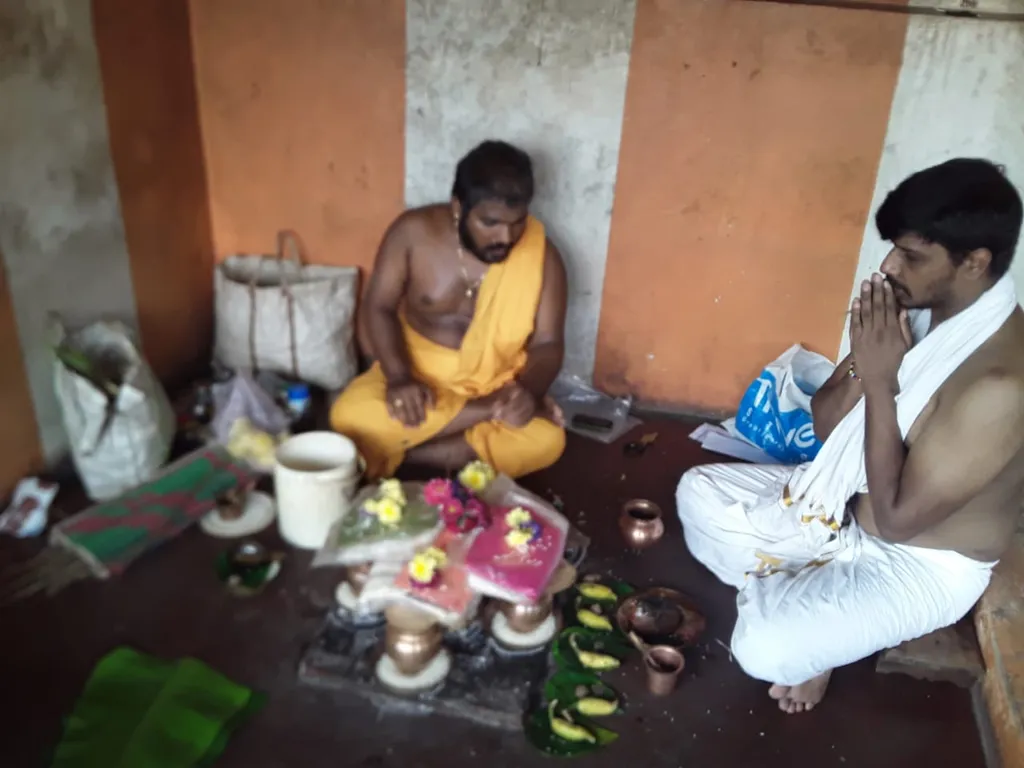
What is Narayan Bali Puja, and what does “Moksha” add?
Narayan Bali is a shraddha-class rite described in the Garuda Purana and followed in the pitru karya tradition across India. In an ordinary death, the prescribed sequence of cremation, the ten- and thirteen-day rites and the annual shraddh carries the departed from the preta state into the company of the pitrus. When death comes in an unnatural or untimely way, or when that sequence is broken, the tradition holds that the transition is left incomplete and the soul remains in the preta state — attached, unsettled, unable to receive the offerings its family makes.
Narayana Bali Puja is the corrective. A symbolic body is constituted for the departed and the rites that were owed are performed over it in full, in the presence of Lord Vishnu as Narayana, so that the soul may finally receive them. It is, in the simplest terms, the funeral that was never properly held — offered late, offered completely, and offered before the deity who is invoked as the refuge of the departed.
The word bali here does not mean sacrifice in the sense of killing anything. Nothing living is harmed at any point in this ceremony. Bali in this context is an offering placed for a being who cannot take it for themselves, and every item used is vegetarian — rice, sesame, ghee, water, darbha grass, flowers and a banana stem or leaf. Families who arrive expecting something else are always relieved to learn this, and it is worth saying plainly.
Who should perform Moksha Narayana Bali Pooja?
This is the section most pages leave out, and it is the one that matters. The rite is traditionally performed when a death in the family falls into one of these circumstances. Read them without alarm — this is a list of situations, not a list of accusations.
- Apamrityu or akal mrityu — death out of its natural time. Road and rail accidents, drowning, fire, electrocution, a fall, a snakebite, an animal attack, a workplace accident, death in an epidemic, or a life taken by violence.
- Suicide. Families carrying this grief often hesitate to ask. The shastras prescribe the rite for exactly this, and the question is asked and answered here without judgement.
- A body that was never recovered. Deaths at sea, in floods or landslides, in war, in a disaster where remains could not be identified, or a person who went missing and was in time presumed dead.
- Last rites that could not be completed. A death far from home or abroad where no family member could perform the karma, a cremation carried out by strangers, a hospital or state disposal, or ashes that were never immersed. Where the ashes are still with the family, asthi visarjan at Gokarna is usually taken up along with this rite.
- The death of a child or an unmarried young person, and the loss of a pregnancy or an infant, for whom the usual shraddha cycle was never begun.
- A lineage where the annual shraddh simply stopped. Generations pass, a family moves, records are lost, and nobody has offered the shradh, tarpan or pind daan for a very long time.
Families also come after a jyotishi has read pitru dosha or pitra dosh in a horoscope, or after a run of difficulty that the elders attribute to the pitrus. Where the underlying issue is an ancestral curse rather than a particular unnatural death, the more appropriate remedy may be a Pitru Dosha nivarana and parihara at Gokarna, or the tarpana and pinda offerings of Preta Dosha (Pretha Dosha) shanti. Describe the situation on the phone and you will be told which rite is actually indicated, even when it is not this one.
Call +91 83109 37047 (Vishu Guruling) for all Gokarna pooja details
WhatsApp UsIs Narayan Bali the same as Narayan Nagbali or Naga Bali?
These three names are constantly confused, and booking the wrong one wastes a journey. The distinction is simple.
- Narayana Bali addresses the departed soul — an unnatural, untimely or unrited death, and the preta state that follows it. That is this page.
- Naga Bali, written equally often as Nagbali, Nagabali or Nag Bali, is a rite of atonement for harm caused to a serpent, and for the naga dosha or sarpa dosha that is held to follow from it. It is performed separately, with its own vidhi; see Naga Bali puja at Gokarna.
- Narayan Nagbali — Narayana Nagabali in the southern spelling — is the two rites performed together over consecutive days, for families in whom both causes are read. This is the form most searched for nationally, and it is explained in full on Narayan Nagbali pooja at Gokarna.
If your horoscope shows kaal sarp dosh alongside an ancestral affliction, the combined observance is usually the one advised, sometimes with Kaal Sarp Dosh nivaran taken up on the same visit. Do not decide this from a search result. It takes one phone call to settle.
Why perform Narayana Bali Puja at Gokarna?
Gokarna in Uttara Kannada district, on the Karnataka coast, is one of the ancient mukti kshetras of the Indian tradition and is called Dakshina Kashi — the Kashi of the south — precisely because rites for the departed are held to carry their full weight here. The town is also known as Bhookailasa, the Kailasa on earth, from the Puranic account of Ravana and the Atmalinga that the Mahabaleshwar Temple enshrines. For pitru karya this matters: a rite performed at a kshetra sanctioned by the shastras for that purpose is not the same as the same words spoken elsewhere.
Practically, families choose Gokarna over Trimbakeshwar, Nashik or Gaya for a few plain reasons. The Koti Teertha tank and the sea meet in one small town, so the tarpana, the pinda offerings and, where needed, the immersion can all be completed without moving between cities. The crowds are smaller than at the northern kshetras, which means the vidhi is not hurried. And the rite is conducted by a purohit who explains each step in Kannada, Hindi or English as the family prefers, rather than performing it silently over you. If you have not visited before, this introduction to Gokarna covers the town itself.
One clarification worth making, because it costs people whole days: Gokarna in Karnataka is not Gokarna in Nepal, and it is not the Mahabaleshwar hill station in Maharashtra. Shree Mahabaleshwar Temple, Gokarna, is on the Karnataka coast in Uttara Kannada, and the nearest railhead is Gokarna Road.
Narayan Bali Puja vidhi — the procedure step by step
The vidhi below is the shape of the ceremony as it is conducted at Gokarna. Every step is explained to the family as it happens, so nobody sits through a rite they do not understand.
- Fixing the tithi and the sankalpa details. Before anything else, the day is chosen and the names, gotras and — where known — the nakshatra and tithi of death are recorded. The sankalpa binds the entire ceremony to your specific family and to a specific departed person; nothing that follows works without it.
- Snana and kshetra shuddhi. The family bathes, and the ritual space within the temple precincts is purified. Where the fuller purification rites are indicated, Kshetra Vidhi is performed first.
- Invocation of Narayana. An altar is prepared with an image of Lord Vishnu and the offerings of flowers, fruits, incense and lamps. The priests invoke Vishnu as Narayana, the preserver, in whose presence the departed is to receive what was owed.
- Constituting the symbolic body. The departed is represented by a figure made of darbha grass or a banana stem, laid on a banana leaf before the deity. This is the heart of the rite: the soul that had no proper body for its rites is given one.
- The bali and the pinda offerings. Cooked rice and the prescribed vegetarian offerings are placed for the departed, and the pinda are offered with mantras. Water, rice, tila (sesame) and ghee are offered through the sequence — the same substances that carry every pitru karya from tarpana to pind daan at Gokarna.
- The prescribed rites, performed in full. The stages of the funerary sequence that were never completed are conducted over the symbolic body, with the hymns and mantras that belong to each, so that the soul is carried from the preta state to the pitru state.
- Homa and tarpan. Where the family's situation calls for it, a fire ritual — most often Thila Homam, also called Tila Homa or Tila Havana — and tarpana for the wider lineage are added on the same day.
- Daana, brahmana bhojana and prasadam. The ceremony closes with the offerings and the giving that the shastras attach to shraddha rites, and prasadam is distributed among the family — the point at which most families first breathe out.
What the rite is traditionally held to accomplish is release: the departed passes out of the preta condition and into the ancestral fold, and the family is free to resume the ordinary annual shraddha for them. No priest can promise you an outcome in your own life, and you should be wary of anyone who does. What is offered here is that the rite is performed correctly, unhurriedly and in full.
How many days does Moksha Narayana Bali Pooja take?
The ceremony itself is a single-day observance of roughly three to four hours. Families are nevertheless advised to keep two days free in Gokarna, because it is customary not to take darshan at the temple on the day of the pooja, and because arriving the previous evening lets the sankalpa details be settled without rushing. Your exact reporting time is confirmed when the date is fixed.
If both Narayana Bali and Naga Bali are indicated, the combined Narayan Nagbali observance runs across two to three days and needs to be planned as a proper trip rather than a stopover. If you are travelling from Bengaluru, Pune, Mumbai or Hyderabad, say so on the call and the day will be arranged around your arrival.
What are the best dates for Narayan Bali Puja?
Amavasya is the classical day for this rite, and the sixteen days of Pitru Paksha — the Mahalaya Paksha, closing with Sarva Pitru Amavasya — are the most auspicious window of the year for it. Ekadashi is also observed for Narayana Bali, given the rite's connection with Vishnu. A death anniversary or the tithi on which the person died is another natural choice.
These are also, inevitably, the days when Gokarna is fullest. Slots, priests and rooms all come under pressure at once during Mahalaya Paksha, and families who call in the last week of the fortnight usually end up with a tithi that was not their first preference. If your rite falls in that window, see Pitru Paksha shraddha, tarpan and pind daan at Gokarna and book early. Outside these windows, suitable days are available through most of the year; a few periods are avoided, and the purohit will steer you away from them when you call.
Who is eligible to perform Narayana Bali?
The sankalpa is traditionally taken by a male member of the lineage — the son first, and in his absence a grandson, brother, nephew, or another sapinda relative of the same gotra. The rest of the family, women included, attend throughout and take part in the offerings; this is a family rite, not a solitary one, and it is better performed with the household present than alone.
Where there is no male relative, or where the one relative who could perform it cannot travel — a common situation for families settled abroad — the shastras provide for the rite to be performed on the family's behalf. In that case the sankalpa still carries your name, gotra and the details of the departed. How that is arranged is covered under online pooja booking at Gokarna. Tell us who is actually available and the correct arrangement will be explained before you commit to a date.
What is the cost of Moksha Narayana Bali Pooja at Gokarna?
You will not find a figure on this page, and that is deliberate. The dakshina for this rite depends on its scale, on how many priests officiate, on the samagri list, on whether a homa or Naga Bali is being added, and on how many family members attend. Publishing an average would only mislead the family whose circumstances are not average.
What you get instead is one amount, given on the phone, with the inclusions read out to you — the pooja samagri, the officiating priests, the sankalpa and vidhi as per shastra, the formalities in the temple compound, seating for your family, prasadam and guidance on where to stay. Travel, rooms and meals you arrange and pay for directly, and we will tell you honestly how many nights you need. The reasoning behind all of this is set out on pooja cost at Gokarna.
What should I prepare before the puja?
Keep these ready and the day runs smoothly. Bring the name and gotra of the departed, your own name and gotra, the date or tithi of death and the nakshatra if you have it, and be prepared to describe the circumstances of the death honestly — that detail decides which rite is correct. A photograph of the departed is welcome but not required.
From the previous day, keep a simple satvik diet without onion and garlic, and avoid alcohol and non-vegetarian food. Bathe before the ceremony and wear traditional dress: dhoti and uttariya for the man taking the sankalpa, saree or salwar kameez for the women. Everything else — the samagri, the darbha, the pinda ingredients, the tila and ghee, the temple arrangements — is arranged for you. If you would like to see how a ceremony here looks before you travel, the pooja gallery has photographs from rituals conducted at the kshetra.
How do I book Moksha Narayana Bali Pooja at Gokarna?
- Call +91 83109 37047, or +91 88613 21496 if the first line is engaged. If you would rather write first, send your details through the enquiry form and you will be called back.
- Describe what happened, not the ritual you think you need. If the correct remedy turns out to be a shraddh, a Preta Dosha shanti or the combined Narayan Nagbali, you will be told so.
- Give the sankalpa details — names, gotra, tithi or nakshatra of death — so the day can be chosen properly.
- Settle the date, the amount and the stay. You will be told how many days to keep free, where to stay within walking distance of the temple, and what to bring.
You can also read about Vishweshwar D. Bhat Gurulingaji and the purohits who conduct these rites, or see the full list of pooja and puja services at Gokarna if you are still working out what your family needs.
Moksha Narayana Bali Pooja at a glance
| Duration | 1 day (approx. 3–4 hours) |
|---|---|
| Best days & tithis | Amavasya, Pitru Paksha, Ekadashi |
| Who performs / attends | A male family member of the lineage, with family |
| What we arrange | Pooja samagri, priests, temple formalities, stay guidance |
| Where | Shree Mahabaleshwar Temple compound, Gokarna, Uttara Kannada, Karnataka |
| Dakshina | Quoted on enquiry |
Frequently asked questions
What is Narayan Bali Puja, and is it the same as Moksha Narayana Bali?
Who should perform Narayan Bali Puja?
How many days does Moksha Narayana Bali Pooja take at Gokarna?
Is Narayan Bali the same as Narayan Nagbali?
Who can perform Narayana Bali — can a daughter or a wife do it?
Can Narayana Bali be performed for a death that happened many years ago or abroad?
What does Moksha Narayana Bali Pooja cost at Gokarna?
Do I need to know the gotra and nakshatra of the departed?
Do I need to fast before the puja, and what should I wear?
Related poojas at Gokarna
Narayan Nagbali Pooja
The combined Narayana Bali and Naga Bali rite performed together for release from ancestral and serpent doshas.
Tripindi Shraddha
Three-pinda offering honouring paternal, maternal and one's own ancestral generations.
Naga Bali
Ritual to pacify naga dosha and seek the protection of the serpent deities.
Perform Moksha Narayana Bali Pooja at Gokarna
Speak to Vishweshwar D. Bhat Gurulingaji for auspicious dates, the vidhi procedure and complete arrangements for your visit.