
Gokarna is a temple town in Uttara Kannada district on the Karnataka coast, where the last ridges of the Western Ghats meet the Arabian Sea. The name means "cow's ear": tradition holds that Lord Shiva emerged here from the ear of the earth in the form of a cow. That story is why the town is a kshetra and not merely a place — the ground itself is held to be consecrated, and rites performed on it to carry a weight they would not carry elsewhere.
Devotees come for two different reasons, both answered within the same square mile: darshan of the Atmalinga at Shree Mahabaleshwar Temple, or something left unfinished for their dead — a shraddha never performed, an asthi visarjan never done, a pitru dosha an astrologer has traced back three generations. This page explains what makes the kshetra what it is, so the poojas and pujas performed here make sense before you book one.
Gokarna is also known as: Dakshina Kashi (Dakshin Kashi) · Bhookailasa (Bhu Kailasa) · Gokarna Kshetra · Mukti Kshetra · the Atmalinga Kshetra · Gokarn
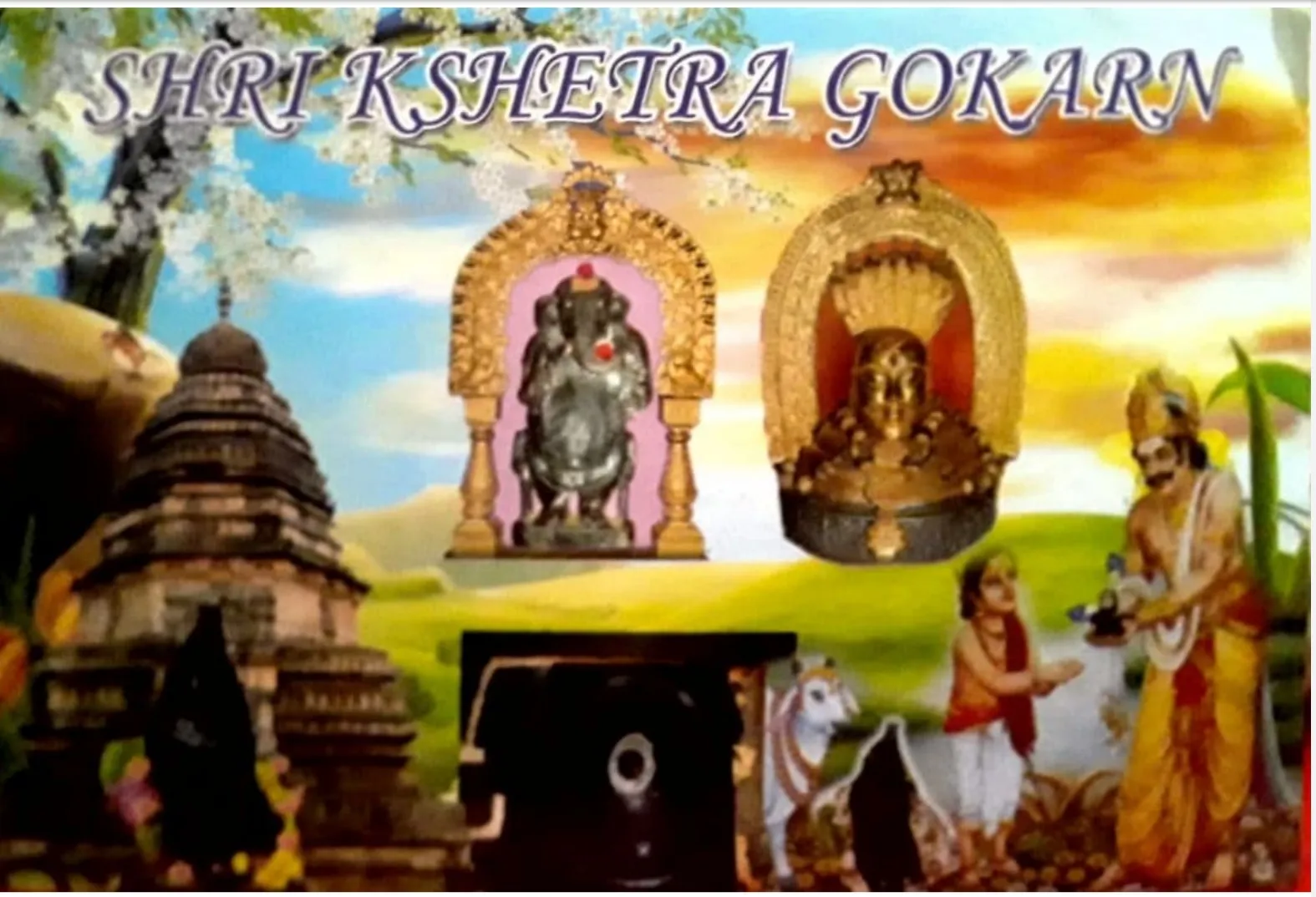
Where is Gokarna, and why is it called a kshetra?
Gokarna sits between Karwar and Kumta in Uttara Kannada, Karnataka — worth stating plainly, since Gokarneshwar in Nepal and the Maharashtra hill station of Mahabaleshwar are constantly confused with it. A kshetra (kshethra) is a field of merit, a place the shastras identify as fit for particular acts, and Gokarna qualifies on every count: a self-manifested linga, a great teertha in Koti Teertha, the shore of the sea, and two rivers meeting that sea on either side of the town. Shiva kshetra, teertha and sangama together are what pitru karya calls for, which is why families have come here for shraddha and shradh rites for as long as the rites have been recorded.
Why is Gokarna called Dakshina Kashi?
Because devotees have long ranked it beside Kashi itself. Kashi's standing rests on a linga of Shiva, a great teertha, and water that carries away what is offered; Gokarna has all three — the Atmalinga in the sanctum, Koti Teertha for the ritual bath and the tarpana, and the Arabian Sea to receive what the shastra says must be given to water. Where a family in the north travels to Kashi or Gaya, a family in the south has been able to come here, and the epithet Dakshina Kashi — written by many devotees as Dakshin Kashi — records exactly that.
The claim is not a modern marketing line: Gokarna's mahatmya is set out in the Skanda Purana, which devotes a whole section to this kshetra. Practically, the epithet means one thing — a rite performed at Gokarna is complete in itself, not a substitute for one performed somewhere more famous.
What is the Atmalinga, and how did Ravana bring it to Gokarna?
The Atmalinga is the linga said to be Shiva's own — his Pranalinga, the seat of his atman, as distinct from a linga installed by human hands. The Skanda Purana's Gokarna Mahatmya tells how it came to rest here.
Ravana, after severe penance, obtained the Atmalinga from Shiva on Kailasa on one condition: it must not touch the earth before he reached Lanka, for wherever it was placed, there it would remain. The devas, alarmed at what he would become with it, appealed to Vishnu and Ganesha. As Ravana neared this coast, dusk was made to fall so that he had to perform his sandhya vandana, and Ganesha appeared before him as a boy. Ravana asked the boy to hold the linga; the boy agreed on the condition that he would call three times and then set it down. He called three times, placed the Atmalinga on the ground, and it could not be lifted again. Ravana pulled with all his strength and the linga only twisted in his grip — which is why the lord here is Mahabaleshwara, the lord of great strength.
The parts of the linga's covering that Ravana flung away in his rage are, by tradition, the places that became Sajjeshwara, Gunavanteshwara, Murudeshwara and Dhareshwara — the other Shiva shrines of this coast. Ganesha is honoured first at the Maha Ganapati temple beside the main shrine, because it was he who ended the matter.
Why is Gokarna called Bhookailasa?
Bhookailasa — also written Bhu Kailasa — means "Kailasa upon the earth". The epithet follows from the Atmalinga story: what stands in the sanctum came from Kailasa and never went back, so the abode of Shiva is held to be present here in the ordinary world. Where the linga is, tradition says, Kailasa is — and that is why Gokarna is treated as a place of liberation and not only of worship.
Is Gokarna one of the seven mukti kshetras?
Yes — Gokarna is counted among the seven great kshetras of the Parashurama coast that tradition treats as mukti sthalas, the sites where moksha (moksh, mukti) is sought. That is a different list from the seven mokshapuris of the north; it belongs to this stretch of the Karnataka shore, which tradition holds Parashurama raised from the sea.
The consequence for a visiting family is not abstract. A mukti kshetra is where the shastras hold that rites for the dead have their full effect — where a soul held in the preta state may be released to join the pitrus. It is why Moksha Narayana Bali pooja at Gokarna carries the word moksha in its name.
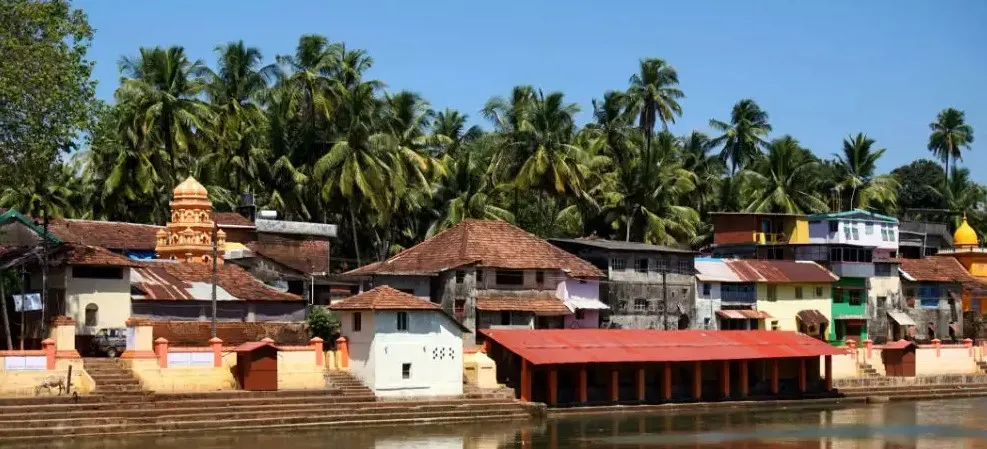
What is Koti Teertha, and why is pind daan offered there?
Koti Teertha — often written Kotiteertha — is the great tank a short walk from the temple. The name says a crore of teerthas: tradition holds that the sacred waters of the land are present in it, so a bath here stands for a pilgrimage to many. It is the working centre of every ancestral ritual in Gokarna. The family bathes here before the rite, the tarpana and tarpan offerings of water and sesame are made here, and the pindas of pind daan at Gokarna — pinda daan, pinda pradana, in the southern phrasing — are offered on its steps.
Because so much of the pitru karya happens at the tank rather than in the sanctum, families are often surprised how much of the day is spent beside water. See the tank on our Gokarna lake and Koti Teertha page.
What is Rudrapada at Gokarna?
Rudrapada is the spot venerated as the footprint of Rudra — of Shiva himself — near the temple. Devotees offer there in the course of pitru rites, and it is one of the named teerthas that give the kshetra its standing, alongside Koti Teertha, the sea shore and the Tamra Parni association preserved in the Tamra Gauri shrine. A family performing shraddha here moves between several consecrated points, not one hall.
Where do the Aghanashini and Gangavali rivers meet the sea?
Two rivers reach the Arabian Sea on either side of Gokarna: the Aghanashini — the name means "destroyer of sin" — south of the town, and the Gangavali, also called the Bedthi, to the north. Gokarna therefore stands between two river-sea sangamas, and a sangama is exactly the water the shastra prescribes for immersion and for the concluding acts of a rite.
It is why asthi visarjan at Gokarna is performed here so often: the ashes are given to water that is both river and sea. The same geography is why the shoreline is ritual ground and not only scenery, though the beaches are worth an evening — see Gokarna beach.
| Shree Mahabaleshwar Temple | The sanctum of the Atmalinga; darshan, abhisheka and the temple poojas |
|---|---|
| Koti Teertha | Ritual bath, tarpana and pind daan for the pitru pujas |
| Rudrapada | The footprint of Rudra, venerated in the course of ancestral rites |
| Maha Ganapati temple | Ganesha, who set the Atmalinga down here, honoured before the main darshan |
| The sea shore and the sangamas | Asthi visarjan and the concluding immersions, where the Aghanashini and Gangavali meet the Arabian Sea |
Which poojas are performed at the temples of Gokarna Kshetra?
Alongside the ancestral rituals, the temples of the kshetra perform the regular poojas devotees ask for. The prominent ones:
- Mahapooja: the elaborate, comprehensive worship of Lord Shiva at the Mahabaleshwar Temple, performed by the priests on the devotee's behalf.
- Rudrabhishekam: the Vedic abhisheka pouring milk, curd, ghee, honey and water over the Shiva linga to the chanting of the Rudram, seeking blessings and the removal of obstacles.
- Ganapathi Pooja: worship of Lord Ganesha, the remover of obstacles, offered in many shrines of the kshetra with flowers, modaka and prayers.
- Navagraha Pooja: the rite addressed to the nine grahas, to soften adverse planetary influence and seek their favour for the family.
- Dakshinavarti Shankha Pooja: puja with the sacred right-turned conch, performed on auspicious occasions and festivals.
- Tailabhishekam: the anointing of the Shiva linga with oil, offered by devotees seeking good health and wellbeing.
These vary in their offerings and their sequence from one shrine to another within the kshetra. Our overview of Gokarna pooja and other temple poojas sets them out in more detail.
Which ancestral rituals are performed at Gokarna, and where?
Pitru karya is the reason most families reach us. Moksha Narayana Bali — Narayan Bali puja — is performed for a death that was untimely or unnatural, or where the last rites were never completed; Narayan Nagbali joins it with Naga Bali when a serpent dosha is present too; Tripindi Shraddha, or Tripindi Shradh, answers three generations at once; and pitru dosha nivarana and parihara — pitra dosh nivaran, in the northern phrasing — is taken where the horoscope and the family history both point to an ancestral cause. Almost all of them begin with the kshetra vidhi and a bath at Koti Teertha, use the tank for tarpana and pinda, and end at the shore. That is the sequence the geography dictates.
Call +91 83109 37047 (Vishu Guruling) for all Gokarna pooja details
WhatsApp UsWhy perform pitru karya at Gokarna rather than Gaya, Kashi or Trimbakeshwar?
Gaya, Kashi and Trimbakeshwar are great kshetras and nothing here argues otherwise. What we ask you to weigh is that Gokarna's standing rests on its own scriptural ground, not on being a nearer substitute for theirs: the Atmalinga described in the Skanda Purana, Koti Teertha and the two sangamas as the prescribed waters, and a place among the mukti kshetras of this coast. A shraddha, a pind daan or a Narayana Bali performed here is complete.
Three practical things usually decide it. Distance — for families in Karnataka, Andhra Pradesh, Telangana, Tamil Nadu, Kerala, Goa and coastal Maharashtra, Gokarna is a far shorter journey than Gaya or Nashik. Language — the puja is chanted in Sanskrit and explained in Kannada, Hindi or English. Pace — fewer families sit here in a day, so the rite is not run against a clock. If another kshetra suits your family better, go there with our blessing; but do not go believing Gokarna is a lesser place, because the shastra does not say so.
When is the best time to visit Gokarna, and how many days do you need?
October to February is the easiest season on this coast — dry and mild. The south-west monsoon from June to September leaves Gokarna green but wet, and Maha Shivaratri, with the Rathotsava when the deity is taken in procession, brings the largest gathering of the year. For pitru karya the tithi matters more than the season: Amavasya and the sixteen days of Pitru Paksha are the prescribed window, and those dates are taken up early.
Plan one full day for darshan with a shorter rite, two to three days for a multi-day ritual with the kshetra vidhi before it. Speak to Vishweshwar D. Bhat Gurulingaji, Kshetra Gokarna Purohit, or write from the contact page, and you will be told the suitable tithis for the month you can travel.
Plan your visit to Gokarna Kshetra
Where to go next if you are preparing a puja or a pilgrimage.
-
Shree Mahabaleshwar Temple, Gokarna
The sanctum of the Atmalinga and the centre of the kshetra.
-
All pooja services at Gokarna
Every ritual we perform, with the vidhi, the days needed and how to book.
-
Moksha Narayana Bali Pooja
Narayan Bali puja for an untimely death or an incomplete shraddha.
-
Online and remote pooja booking
When the family cannot travel, the rite performed at Gokarna in your name.