
Not every family that owes a ritual to its ancestors can reach Gokarna. A son is posted in Dubai or New Jersey, a mother is too frail for the overnight bus from Bengaluru, a leave application will not clear before Mahalaya Amavasya has passed. The question we are asked most often on the phone is a very plain one — can the pooja still be done if we cannot come? For most of the rites performed at Shree Mahabaleshwar Temple, the answer is yes.
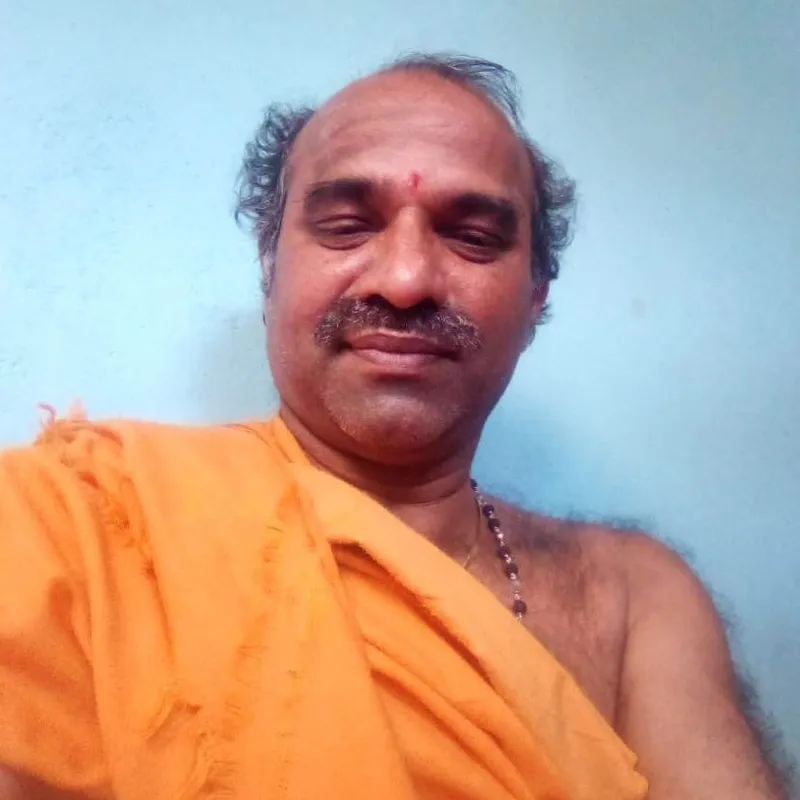
The ritual is performed here in the kshetra by Vishweshwar D. Bhat Gurulingaji, in your name, your gotra and your nakshatra, while your family joins over a live video call from wherever it is. This page sets out how an online puja at Gokarna works, why a rite performed through a purohit is permissible rather than a modern convenience, what we need from you, what reaches you afterwards — and where the honest limits lie, because there are some.
| What it is | A full Vedic pooja performed at Gokarna on a devotee's behalf, not a ritual conducted over a screen |
|---|---|
| Who books it | NRI families, out-of-state devotees, elderly or unwell kartas, families with a fixed tithi and no leave |
| What we need from you | Names, gotra, nakshatra, the departed ancestor's details and the reason for the rite |
| How you take part | A live video call at the sankalpa, the principal offerings and the concluding ashirvada |
| Rituals commonly booked | Narayan Bali, Nagbali, Tripindi Shraddha, pind daan, tarpana, Thila Homam, pitru dosha parihara |
| Languages | Kannada, Hindi and English for the explanation; the mantras in Sanskrit |
| Dakshina | Depends on the ritual, its duration and the samagri — call for the exact amount |
| To arrange | +91 83109 37047 or +91 88613 21496 |
What is online pooja booking at Gokarna?
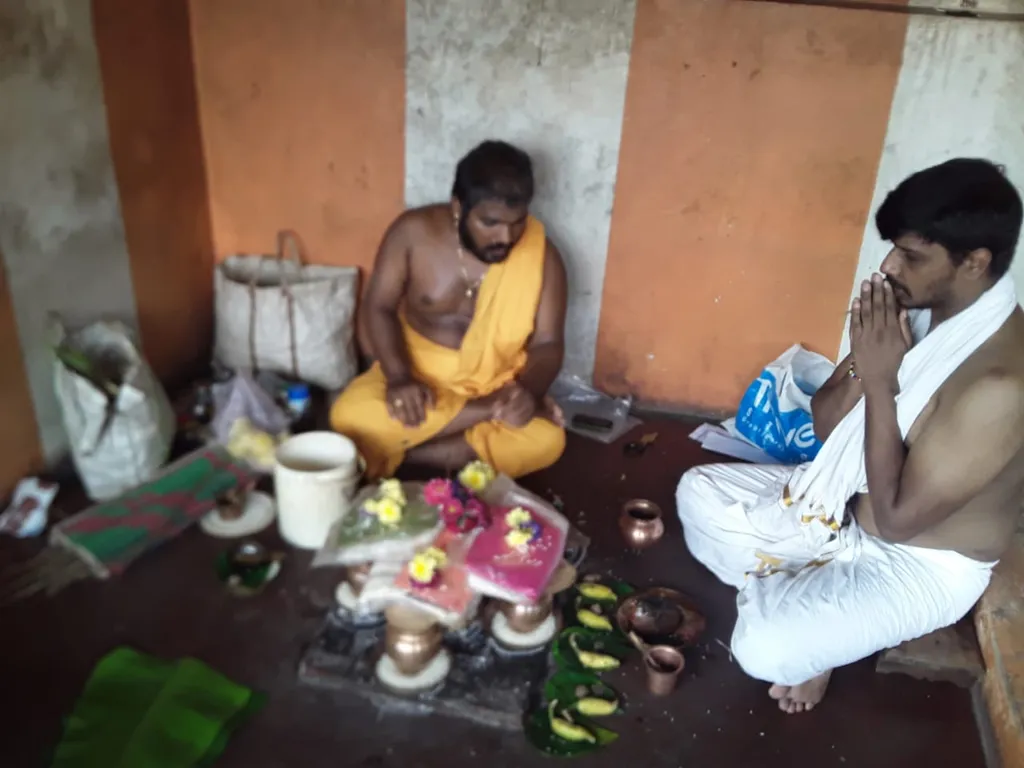
Online pooja booking does not mean a pooja that happens on a screen. It means the karma is performed in full at Gokarna — the same vidhi, the same samagri, the same muhurta, the same Koti Teertha and the same temple compound — while the family that has commissioned it participates from a distance instead of standing on the spot. Nothing about the ritual is abridged because you are absent. What changes is only whose hands hold the darbha and pour the tarpana water: the purohit does it as your representative, with your sankalpa spoken aloud in your name.
Devotees look for this in a dozen different ways — gokarna online puja, e-puja gokarna, virtual pooja booking, pooja performed on my behalf. They all describe the same arrangement, and it is not a new one. Long before video calls existed, families across Karnataka, Maharashtra and Andhra sent the names and gotras of their departed to a Gokarna pujari and had the shraddha performed here while they kept the fast at home. The camera has added participation; it did not create the practice.
Can I do Narayan Bali puja without going to Gokarna?
In most circumstances, yes. Moksha Narayana Bali pooja — Narayan Bali puja, as devotees in the North and West usually write it — is the shraddha prescribed for a soul that left the body without the proper samskaras, whether through an untimely death, an accident or a death whose rites were never completed. The Garuda Purana, which is the scriptural ground for the rite, is concerned with whether the karma is performed correctly and in the right kshetra. It does not make the merit conditional on the geographical position of the family that has commissioned it.
The same reasoning covers the combined Narayan Nagbali pooja at Gokarna, the Naga Bali or nagabali rite for sarpa dosha, Tripindi Shraddha for three unsatisfied generations, and the Thila Homam (Tila Havana) offered as a pitru dosha parihara. Where a rite genuinely needs the karta's own body present, we say so plainly — and the section on limits further down lists exactly which ones those are.
Why is a puja performed in your absence valid in shastra?
Every Vedic ritual opens with the sankalpa, the formal declaration that fixes the rite in space and time and names the person for whom it is being performed. Spoken with water in the palm, it states the desha — the place — then the kaala, the samvatsara, ayana, ritu, masa, paksha and tithi, then the yajman by gotra, nakshatra and name, and finally the purpose: pitru dosha nivarana, preta shanti, moksha for a named ancestor.
Notice what the sankalpa binds and what it does not. The desha is Gokarna — Dakshina Kashi, one of the sapta mukti kshetras, the Bhookailasa where Lord Shiva's Atmalinga was set down and could not be lifted again, as the Skanda Purana relates. The person is you, identified by gotra and nakshatra, which is why those two details are asked for so insistently. The physical presence of the yajman's body in the courtyard is simply not one of the elements the sankalpa fixes.
Dharmashastra has also long provided for the pratinidhi — a qualified representative who performs a rite when the person obliged to perform it cannot. It is the same provision under which a younger brother performs shradh for an ailing elder, and under which any family engages a purohit at all. Remote participation is the modern shape of a very old allowance, not a departure from it. What it does not licence is carelessness: the details must be correct, the tithi right and the vidhi complete.
What details does your family need to provide?
Almost everything we ask for exists to make the sankalpa accurate. Have these ready before you call, and the booking conversation takes ten minutes instead of three phone calls:
The karta and the family
Full name and gotra of the person in whose name the pooja is taken, plus the names of family members joining the call.
Nakshatra or rashi
Birth star of the karta where it is known. If it is not known, say so — there is a prescribed substitution.
The departed ancestor
Name, gotra, relationship to you, approximate date or tithi of death, and whether the death was untimely or unnatural.
Reason for the rite
Pitru dosha or pitra dosh indications, sarpa dosham, a shraddha never performed, a family astrologer's advice — describe it in your own words.
Horoscope, if relevant
Needed only for astrological remedies such as Kaal Sarp Dosh nivaran, where the Rahu-Ketu placement decides the vidhi.
Contact and language
A number reachable on the pooja day, and whether you would prefer the explanation in Kannada, Hindi or English.
If a gotra or a date of death has been lost — and in a great many families it has — say so rather than guessing. There are prescribed substitutions for an unknown gotra and for an unknown tithi, and the purohit will apply the correct one. A wrong gotra spoken in the sankalpa is a far worse problem than an honestly declared unknown one.
Call +91 83109 37047 (Vishu Guruling) for all Gokarna pooja details
WhatsApp UsHow does the video call during the puja work?
Most rituals at Gokarna run three to four hours, and some — Narayan Nagbali and Naga Pratishta among them — run across two or three days. No family is expected to sit through the whole of that on a call. The call is arranged around the parts where your participation genuinely matters: the sankalpa at the start, when your name and gotra are spoken aloud; the principal offerings and the homa; and the concluding ashirvada.
Two practical points. First, timings follow Indian Standard Time, because muhurtas are computed for the place and cannot be shifted to suit a time zone. Families in the Gulf, Singapore or Australia find the window easy; families in North America should expect an early-morning or late-night call. Second, which calling application is used and who dials whom is settled on the phone in advance — a temple compound mid-homa is no place to troubleshoot unfamiliar software.
At your end, keep it simple: a quiet room, a lit lamp if you can manage one, someone holding the phone steady, and temple dress. If the ritual is a pitru karya, the family observes the same discipline it would observe here — the fast until the offerings are complete, and satvik food without onion or garlic. The pooje is being performed for your ancestors whether you are present or not, and the observance travels with the intention.
What do you receive after the online pooja is over?
Families ask for three things after a remote puja: some record of the ritual, the prasada and teertha from the offerings, and a clear account of what was actually performed. All three are ordinary requests and we are used to them.
What we deliberately do not do is publish a fixed promise about format or timing. Whether a recording, photographs or both are practical depends on the ritual and on the day at the temple; how prasada reaches you depends on where in the world you are. Ask when you book, settle it before the date is fixed, and hold us to what was agreed — that is more honest than a guarantee printed on a page nobody can inspect.
What you will always be given is an account of the vidhi — which sankalpa was taken, in whose name and gotra, which offerings were made, at which teertha and on which tithi. For most families that record is the part that settles the mind, more than any video. You can also see the kind of rituals performed here in our Gokarna pooja gallery.
What a remote puja cannot do — the honest limits
A page that claims everything can be done from a distance is selling you something. These are the real boundaries:
- Rites performed on a person need that person. Kshetra Vidhi — the kshoura, the snana at Koti Teertha, the purification that precedes a major pitru karya — is by its nature performed on a body. It cannot be done by proxy.
- Asthi visarjan needs the asthi. Asthi visarjan at Gokarna cannot happen unless the ashes physically arrive here. How they travel is a practical matter to discuss on the phone rather than improvise; once they are in Gokarna, the immersion and the accompanying rites can be performed with the family joining by call.
- Darshan is yours to have, not ours to send. No arrangement can give you the Atmalinga darshan at Shree Mahabaleshwar Temple, the sea at the Gokarna shore or the still water of Koti Teertha. Many families perform the pooja remotely when the tithi will not wait, then travel later for darshan.
- One family member present is better than none. If anyone in the lineage can make the journey, that is the stronger arrangement, and we will say so even when it costs us the remote booking.
- We will decline where the shastra requires presence. For a small number of rites and a small number of family situations, performance in absentia is not appropriate. You will be told that on the first call rather than after you have paid.
How much does an online pooja at Gokarna cost?
The dakshina for a remote booking is worked out exactly as for a family standing in the courtyard: by which ritual you need, how many days it runs, how many priests officiate and what samagri the vidhi calls for. Being absent does not make a rite smaller — the samagri is still purchased, the homa still lit, the brahmanas still fed. What you save by booking remotely is your travel and your stay, not the ritual.
We do not publish rate cards, and you should be wary of anyone in this kshetra who quotes a firm figure before asking which ritual you need and for whom. Call and describe your situation, and you will be given the amount for your rite plainly, together with what is included in it. The page on what determines Gokarna pooja cost explains every component that goes into the calculation, so that you know what you are being told when you hear it.
How do you book an online puja at Gokarna?
Call or WhatsApp
Describe who the pooja is for and what has prompted it — a death anniversary, an astrologer's reading, an unperformed shraddh, a run of family difficulty.
Fix the ritual and the date
The purohit advises which vidhi your situation calls for and the auspicious day for it — Amavasya, a Pitru Paksha tithi, Panchami for naga rites.
Share details and join the call
Send names, gotra and ancestor details, settle the call window and what you will receive afterwards, and be ready at the appointed hour.
If you would rather write it out than say it on the phone — often easier when several ancestors' names and dates must be conveyed — use the enquiry form on our contact page and we will call you back. Devotees who want to know who is performing the rite can read about Vishweshwar D. Bhat Gurulingaji, Kshetra Gokarna Purohit; and if you are unsure which pooja your family needs, the overview of Gokarna poojas and temple rituals is the place to start.
Which Gokarna poojas do families most often book remotely?
Moksha Narayana Bali Pooja
Sacred ritual to free departed souls from the cycle of rebirth and help them attain moksha.
Moksha Narayana Bali Pooja at GokarnaNarayan Nagbali Pooja
The combined Narayana Bali and Naga Bali rite performed together for release from ancestral and serpent doshas.
Narayan Nagbali Pooja at GokarnaTripindi Shraddha
Three-pinda offering honouring paternal, maternal and one's own ancestral generations.
Tripindi Shraddha at GokarnaPitru Shaapa
Remedial rituals to relieve the curse of dissatisfied ancestors and restore harmony.
Pitru Shaapa at GokarnaPind Daan
Pinda offerings and tarpana at Koti Teertha for the peace and liberation of departed ancestors.
Pind Daan at GokarnaPitru Paksha Pooja
Shraddha, Tarpan and Pind Daan rituals during the sacred Mahalaya Paksha fortnight.
Pitru Paksha Pooja at GokarnaEvery rite performed in this kshetra, with its duration and the days it is best done on, is listed on the Gokarna pooja services page. The Nagabali puja FAQ answers the procedural questions devotees ask about the naga rites in particular, and Welcome to Gokarna explains why this small temple town in Uttara Kannada district, Karnataka, is where these rituals are performed at all.
Frequently asked questions
Can I do Narayan Bali puja without going to Gokarna?
Is a puja performed on my behalf accepted in shastra?
What details do you need for a remote puja booking?
Do I have to stay on the video call for the whole pooja?
Will I get a video of the puja after the ritual?
Can pind daan and tarpan be done online at Gokarna?
Can asthi visarjan be done without the family coming to Gokarna?
What does an online pooja at Gokarna cost?
Can a woman book a pooja at Gokarna if no male family member can travel?
Book a pooja at Gokarna without travelling
Speak to Vishweshwar D. Bhat Gurulingaji about which ritual your family needs, the auspicious date for it, and how you will join the puja by video call from wherever you are.