
Skip to content
Gokarna Moksha

Naga Bali Pooja (Nagabali Puja) at Gokarna — FAQ

Answers to the questions devotees ask us most before travelling to Gokarna for Nagbali — days, timings, eligibility, dress, food, samagri and cost.

These are the questions devotees actually ask on the phone before travelling to Gokarna for Nagabali Puja — the rite written variously as Naga Bali, Nagbali or Nag Bali, and called naga bali pooje in Kannada. They are answered by Vishweshwar D. Bhat Gurulingaji, Kshetra Gokarna Purohit, and the priests who perform this pooja in the compound of Shree Mahabaleshwar Temple.

Nagabali Puja at Gokarna is a significant religious ritual performed to honour and pacify the souls of deceased ancestors, and is believed to rid families of problems caused by the neglect of proper funeral rites. If you would rather read the ritual described in full than work through it question by question, start with Naga Bali Pooja (Nagbali Puja) at Gokarna and come back here for the practical details — how many days it takes, who may perform it, what to wear, what to eat and what it costs.
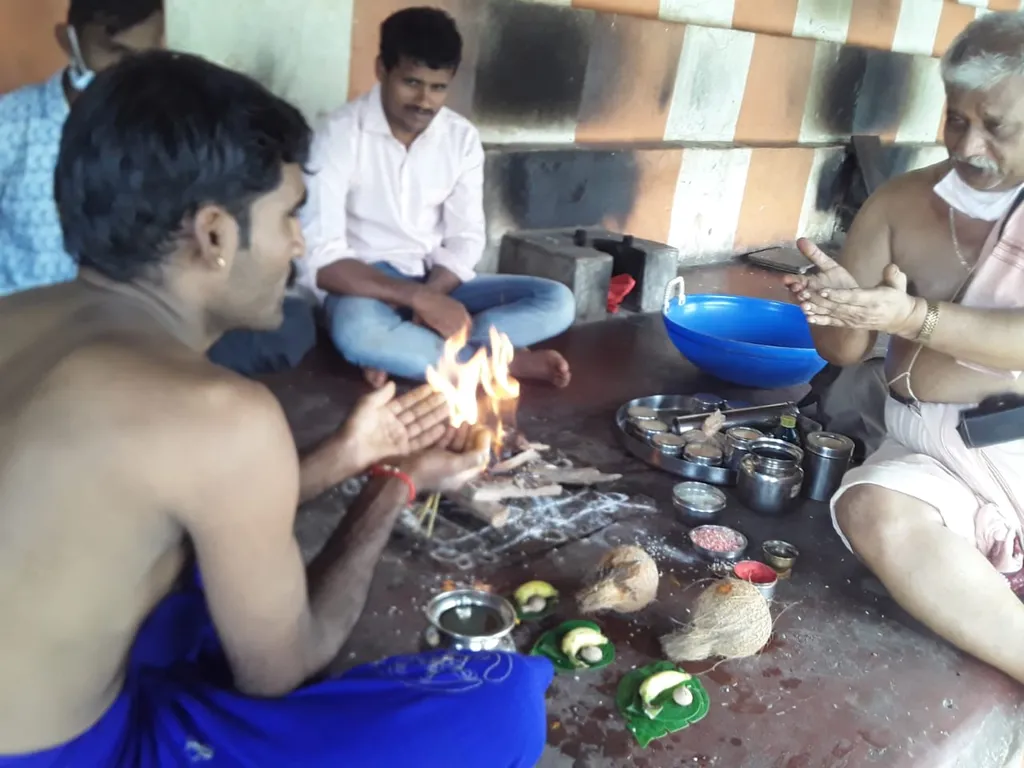
Nagabali puja (Naga Bali pooja) being performed by priests at Gokarna

What is Naga Bali Pooja (Nagbali Puja) performed for?

Two circumstances bring families to this puja. The first is sarpa hatya — a serpent killed or injured, or a naga bana or ancestral naga stone destroyed, by someone in the household or by an ancestor generations back, with no prayaschitta performed at the time. The second is a death in the family that was untimely or unnatural, a snakebite above all, where the funeral rites were never properly completed. In either case the tradition describes the family as carrying naga dosha or sarpa dosha, and Naga Bali is the parihara — the nivarana, in the northern register — prescribed for it.

The difficulties traditionally associated with the dosha are childlessness or repeated miscarriage, delay in marriage, persistent skin ailments, recurring dreams of serpents, and a run of obstruction a family cannot account for. These are read as indications within the tradition, not as a diagnosis of any kind. Many devotees arrive with no remembered incident at all, having simply been told by a jyotishi that the horoscope carries sarpa dosha. Where the reading is of ancestral displeasure rather than serpent dosha, the pitru dosha nivarana and pitra dosh parihara rites are what is usually advised instead.

Nagabali Puja at Gokarna at a glance
Ritual Naga Bali Pooja (Nagabali / Nagbali / Nag Bali Puja)
Duration 1 day (approx. 3–4 hours)
Best days & tithis Panchami, Shravana month, Amavasya
Who performs it A family member, with family present
What we arrange Silver or clay naga idol, abhisheka samagri, priests
Where Shree Mahabaleshwar Temple compound, Gokarna, Uttara Kannada, Karnataka
Dakshina Not a fixed package rate — quoted on the call once the scale of the rite is known
Booking +91 83109 37047 or +91 88613 21496

Why do families travel to Gokarna for Nagabali Puja?

Gokarna has been a place of atonement and release for a very long time, and it is spoken of as Dakshina Kashi and as one of the mukti kshetras for exactly that reason. The Atmalinga at Shree Mahabaleshwar Temple is the heart of the kshetra; around it lie the teerthas that give the prayaschitta rites their setting, chief among them Koti Teertha, where the purificatory snana is taken before a pooja begins. The town and its sacred geography are described on our page on Gokarna, the temple town and its teerthas.

The practical reason families choose Gokarna over a temple nearer home is that these rites are ordinary daily practice here. Naga Bali, Narayana Bali, shraddha and tarpana are performed by priests based in the temple compound rather than arranged as a special occasion, and the samagri, the naga murti and the teertha arrangements are all to hand. Devotees who cannot travel ask us to perform the rites on their behalf — see online and remote pooja booking at Gokarna.

Nagabali Puja at Gokarna: frequently asked questions

What is Nagabali Puja?

Nagabali Puja — written by devotees as Naga Bali, Nagbali or Nag Bali — is a ritualistic offering performed to appease the souls of ancestors who have died unnaturally or prematurely, especially due to snake-related deaths, and to atone for harm done to a serpent. It is believed that performing this ritual helps pacify their souls and provides salvation to the departed spirits. A naga murti in silver or clay is worshipped with abhisheka and mantras, the bali offering is made on the serpent's behalf, and the murti is given visarjana. The full vidhi is on our Naga Bali Pooja page for Gokarna.

Where is Nagabali Puja performed?

Nagabali Puja is primarily performed at the Mahabaleshwar Temple in Gokarna, Karnataka, situated near the Arabian Sea. Gokarna is a renowned pilgrimage site and holds special significance for its association with this ritual. Our priests conduct the pooja within the temple compound, and the purificatory snana before it is usually taken at Koti Teertha. This is Gokarna in Uttara Kannada district — not the Mahabaleshwar hill station in Maharashtra, nor Gokarna in Nepal. See Shree Mahabaleshwar Temple and the Atmalinga.

What are the beliefs associated with Nagabali Puja?

It is believed that if proper funeral rites are not performed for those who have died unnaturally or prematurely, their souls can remain restless and cause misfortunes or problems for their living descendants. Nagabali Puja is performed to rectify this and bring peace to the departed souls. The same tradition holds that harm done to a serpent leaves the family under naga dosha or sarpa dosha until atonement is made. Devotees perform this puja seeking that atonement; the shastras describe it as prayaschitta, not as a guaranteed remedy for any difficulty.

When is Nagabali Puja conducted, and can it be done outside Shravana?

This puja is usually performed during specific auspicious times according to the Hindu lunar calendar, often during the lunar month of Shravana (July–August). The exact dates may vary, but it is commonly performed on days like Amavasya (new moon day) or Mondays during this period, and Panchami tithi — Naga Panchami above all — is the classical choice for anything addressed to the nagas. It can, however, be performed in other months: the panchanga is consulted and a suitable muhurta is fixed for the dates on which your family is able to travel.

How is Nagabali Puja conducted, step by step?

The puja involves a series of rituals performed by priests on behalf of the family members of the deceased. Offerings including food, darbha grass, milk and other items are made to symbolise appeasing the departed souls. In sequence: the family takes the purificatory snana; the sankalpa is spoken with the priest, naming gotra, nakshatra and purpose; a naga murti of silver or clay is installed and invoked; abhisheka follows with the naga mantras; then pooja, naivedya and the prayers of atonement; the bali offering; visarjana of the murti; and teertha and prasadam for the family.

How many days does Nagabali Puja take, and what are the timings?

Naga Bali on its own is a one-day rite, and the ritual portion runs to roughly three to four hours. It begins in the morning after the snana, so families are generally free by the afternoon. The exact starting time is fixed when your date is confirmed, because it depends on the tithi, on the temple's own observances that morning and on how many rituals you are performing. Families travelling a long distance are advised to reach Gokarna the previous evening so the morning is unhurried.

What is the cost of Nagabali Puja at Gokarna?

There is no fixed package rate for this pooja, and we do not publish one, because a single figure would misrepresent what is actually being arranged. The dakshina depends on the scale of the rite, on whether the naga murti is made in silver or in clay, on the samagri required, on the number of priests officiating, and on whether Nagbali is performed alone or with other rituals over several days. Call us on +91 83109 37047 or +91 88613 21496 and you will be quoted for your exact requirement before you commit to a date. Our page on Gokarna pooja cost and what a booking includes explains how the quote is arrived at.

Who should perform Nagabali Puja?

Nagabali Puja is usually performed by family members who believe that their ancestors' souls are restless or have not attained peace due to unnatural or untimely deaths. It is considered a duty to offer this puja to ensure the departed souls find solace. In practice the sankalpa is taken by a member of the lineage in which the dosha is believed to have arisen, with the family present; where an astrologer has read sarpa dosha in one person's horoscope, that person usually takes the sankalpa. Because practice differs between sampradayas, describe your situation on the phone before you travel.

Can a woman, a daughter or a married couple perform Nagabali Puja?

In many sampradayas the sankalpa is taken by a male member of the lineage, and where the family's concern relates to progeny, husband and wife commonly sit for it together. Where no male heir survives, families differ, and some traditions allow a daughter or a widow to perform the rite under the priest's guidance. An unmarried member of the lineage may also perform it. Households and regions genuinely differ here, so tell Gurulingaji who is available in your family and he will say who should sit for the pooja.

Can anyone participate, and how many family members should attend?

Participation is typically limited to family members and the priests conducting the ritual. However, visitors to Gokarna during this time might witness or observe aspects of the puja as it is conducted in public areas. There is no minimum number of relatives you must bring — one person of the lineage may take the sankalpa — and elders, children and other relatives are welcome to sit through the vidhi and receive teertha and prasadam at the close. Tell us how many are coming when you book so the seating and samagri are arranged for your group.

How many priests officiate at Nagabali Puja?

More than one priest is involved. The officiating purohit takes the sankalpa with the family while assisting priests handle the abhisheka, the naivedya and the recitation of the naga mantras. How many are needed depends on the scale at which you perform the rite and on whether Nagbali is being done alone or as part of a longer observance such as Narayan Nagbali, which is a larger undertaking. Tell us what you intend to perform and we will tell you how the pooja will be staffed.

Is Nagabali Puja mandatory?

Nagabali Puja is not mandatory in Hinduism. It is performed by those who believe their ancestors' souls are distressed due to improper funeral rites or unnatural deaths and wish to pacify them. Families most often come after an astrologer has read naga dosha or sarpa dosha in a horoscope, or because an incident of sarpa hatya is remembered in the household, or because a death in the family was untimely and the rites were never completed. No one is obliged to perform it, and nobody should be told that misfortune will follow if they do not.

Is Nagabali Puja the same as Narayan Nagbali?

No, though the two are closely related and the names are often used loosely. Naga Bali is the serpent half of the older compound rite and is completed in a single day. Narayan Nagbali Pooja at Gokarna joins Narayana Bali — performed for a departed soul — with Naga Bali in one longer observance over two to three days, and it is by this compound name that devotees from Maharashtra and North India usually know the ritual. If your concern is only sarpa dosha, Nagabali alone is generally what is prescribed. The two can be performed together; say so when you call so the days are planned in order.

What should I wear for Nagabali Puja?

Traditional dress is customary in the temple compound: a dhoti or veshti with an angavastra for men, and a saree or salwar kameez for women. Wear something you are comfortable sitting in for a few hours, since the vidhi is performed seated. As in any temple, footwear and leather articles are left outside. Bring a change of clothes if you intend to take the snana at Koti Teertha before the pooja, and carry a shawl or towel for the sea and river bathing that some families include.

Do I need to fast, and what are the food rules during the rite?

The person taking the sankalpa customarily eats only after the ritual is complete, and families generally keep to satvik food on the day — without onion or garlic, and without non-vegetarian food or alcohol for the duration of the rite. Where a longer observance runs over more than one day, the same restraint is kept for all of the days. If age, medication or a health condition makes fasting difficult, say so when you book: nobody is expected to endanger their health, and the priest will tell you what is acceptable in your case.

What should I bring, and what samagri do you arrange?

Bring the names, gotra and nakshatra of those who will sit for the sankalpa, and — where the rite is connected with a death — the name and details of the departed. If the gotra is not known, tell the priest in advance, because the tradition provides a prescribed way of taking the sankalpa in that case. Nothing need be purchased beforehand: the naga murti of silver or clay, the abhisheka samagri and the priests are arranged by us. If your family owns a naga murti or an ancestral naga stone you wish to use, bring it and mention it when booking.

Can we have darshan at Mahabaleshwar Temple on the same day as the pooja?

Practice on this differs between rites and between families. For prayaschitta and pitru rituals it is customary to complete the vidhi first and take darshan afterwards, and for longer observances such as Narayan Nagbali many families are advised to keep the darshan for the following day — which is one reason an overnight stay is suggested. Because the rule is not the same for every ritual, ask when your date is confirmed and the priest will tell you when to take darshan of the Atmalinga.

How far in advance should I book Nagabali Puja at Gokarna?

There is no fixed cut-off, but the busiest windows of the year are the Shravana month, Naga Panchami, Amavasya days and the Pitru Paksha fortnight, and families who want a date inside those windows should call well ahead rather than arrive and hope for a slot. Outside them, shorter notice is usually workable. Booking is done by phone or WhatsApp on +91 83109 37047 or +91 88613 21496, or through the Gokarna puja enquiry form, because the right rite and the right date depend on your circumstances.

Which naga pooja does my family need — Naga Bali, Naga Pratishta or Kaal Sarp Dosh Nivaran?

These names are used loosely in conversation and it is easy to book the wrong rite, so it is worth separating them before you call:

  • Naga Bali (Nagbali) is the one-day atonement this page answers questions about, for sarpa dosha arising from harm to a serpent or from an unnatural death in the family.
  • Naga Pratishta (Naga Pratishte) at Gokarna is the consecration and installation of a naga stone for continuing worship, over two days — what a family needs when an ancestral naga bana or naga kallu has been neglected.
  • Kaal Sarp Dosh Nivaran Pooja is the Rahu-Ketu remedy for the kaal sarpa dosha read when every planet falls between the two nodes — a different rite from Nagbali, though both concern the serpent graha.
  • Moksha Narayana Bali (Narayan Bali Puja) is performed for the release of a departed soul; joined with Naga Bali, it becomes the observance devotees call Narayan Nagbali.

If you are unsure which applies, that is the conversation to have on the phone before booking anything. The complete list is on our Gokarna pooja services page.

How do we reach Gokarna, and where do we stay for the puja?

Gokarna sits on the Karnataka coast in Uttara Kannada district. The nearest railway station is Gokarna Road on the Konkan Railway line, with Kumta and Ankola the next stations on either side; buses run to the town from Bengaluru, Mangaluru, Hubballi and Goa, and the closest airports are in Goa and at Hubballi.

Because the Nagabali pooja begins in the morning after the snana, families travelling any distance should reach Gokarna the previous evening rather than the same morning. Rooms of every kind exist in and around the town, from temple-area lodges to guest houses near the beach, and they fill quickly during Shravana and Pitru Paksha. Tell us your dates through the Gokarna pooja enquiry and contact page and we will help you plan the stay around the muhurta.

While these FAQs provide an overview, the specifics and significance of Nagabali Puja may vary according to individual beliefs and customs within families and communities. For guidance on your specific situation, please speak to us directly.

Perform Naga Bali at Gokarna

Speak to Vishweshwar D. Bhat Gurulingaji for auspicious dates, the vidhi procedure and complete arrangements for your visit.

Found this helpful? Share it with family & friends

Book your pooja (puja) at Gokarna Kshetra

Speak to Vishweshwar D. Bhat Gurulingaji for dates, arrangements and guidance.

Book Your Pooja at Gokarna Kshetra

Book Tripindi Shraddha, Naga Pratishte, Kshetra Vidhi and other dharmika vidhis at Gokarna with complete arrangements for visiting devotees — accommodation guidance included. Call us for dates and details.

Call +91 83109 37047 WhatsApp Us