
Pitru Paksha is the one fortnight of the Hindu year set aside entirely for the departed, and its three duties — shraddha, tarpan and pind daan — are performed on the day that belongs to each family. Hindi-speaking families write it pitra paksha and call the rite shradh; in Karnataka and further south it is Mahalaya Paksha and the water offering is tarpana or tarpanam. We perform all of them at Gokarna, in the compound of Shree Mahabaleshwar Temple and at the teerthas around it, for families who come from both registers of that vocabulary.
Also known as: Pitra Paksha Shradh · Mahalaya Amavasya Shraddha · Tarpana · Sarva Pitru Amavasya
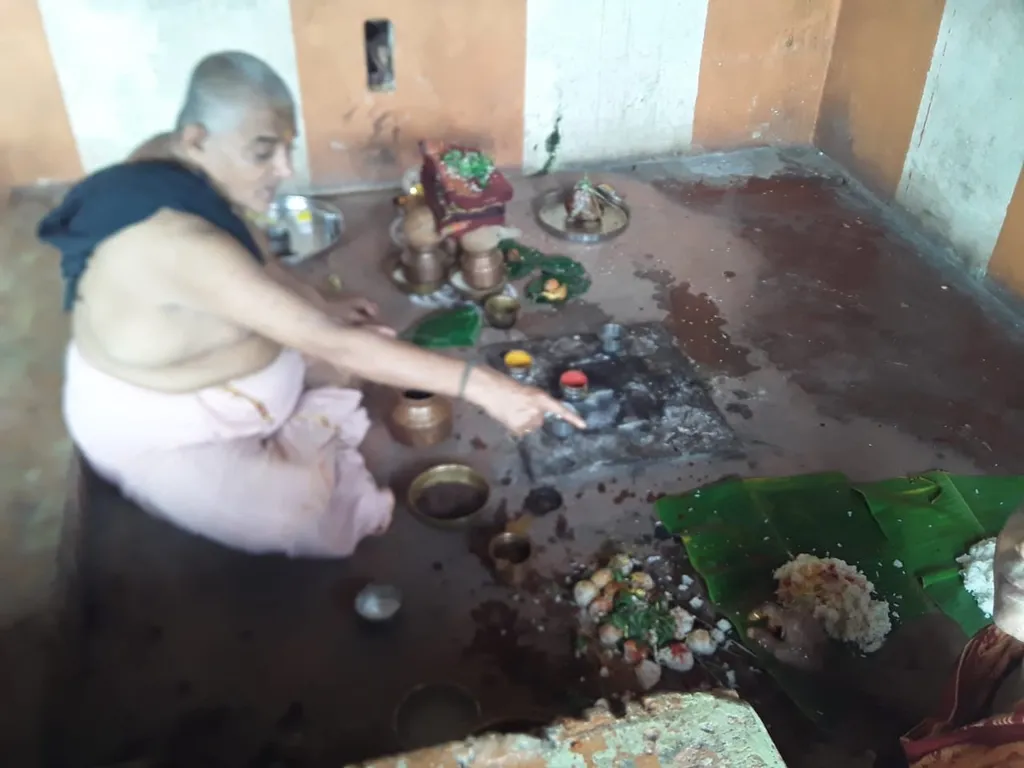
What is Pitru Paksha (Mahalaya Paksha)?
Pitru Paksha is the dark fortnight of the lunar month of Bhadrapada, held in the shastras to be the period in which the pitrus — the pithru devatas of the last three generations and the ancestors behind them — are nearest to their descendants. Every other pitru karya in the year belongs to one family and one death anniversary; this fortnight belongs to all of them at once, which is why it is also called Mahalaya.
What a family owes during these days is not complicated. Water mixed with black sesame is offered as tarpana; rice pindas are offered as pind daan; brahmins are fed and daana is given; and all of it is performed with a sankalpa naming the gotra and the ancestors. Devotees perform it seeking peace for the departed and relief from what is traditionally called pitru dosha or pitra dosh — an act of duty and repayment of the pitru rina, not a transaction with a promised outcome.
Call +91 83109 37047 (Vishu Guruling) for all Gokarna pooja details
WhatsApp UsWhen does Pitru Paksha fall, and why do the dates change each year?
The fortnight begins the day after Bhadrapada Purnima and ends on the Amavasya that closes the month, which normally places it in September or October. Because the Hindu calendar is lunar, those English dates move by about eleven days each year, and a tithi can begin on one day and end on another depending on sunrise — which is why a family that performed shradh on the 25th one year should not simply repeat the 25th the next.
For that reason no fixed calendar of dates is published here: a dated list left un-updated is worse than no list at all, and the panchanga has to be read afresh each year. Call +91 83109 37047 or +91 88613 21496 and the purohit will tell you when this year's fortnight opens, on which day your own tithi falls, and the date of Mahalaya Amavasya.
How are the sixteen days of the fortnight structured?
The fortnight runs tithi by tithi from Pratipada through Dwitiya, Tritiya, Chaturthi, Panchami, Shashti, Saptami, Ashtami, Navami, Dashami, Ekadashi, Dwadashi, Trayodashi and Chaturdashi to Amavasya. Counting Bhadrapada Purnima, on which some traditions begin with Purnima shraddha, that sequence gives the sixteen days commonly spoken of as the fifteen-day period of pitra paksha. Each tithi is a valid day for shraddh; none is a lesser day. The rites are performed in the aparahna, the afternoon portion prescribed for pitru karya, which is why a Gokarna booking begins in the morning.
Which day should you perform shraddha on? Choosing the tithi
The rule most families need is simple: the shradh is performed on the tithi of the fortnight that matches the tithi on which the ancestor died. If your father passed away on a Saptami — of any month, in any year — his shraddha falls on the Saptami of this fortnight. The English date is irrelevant; only the tithi is carried forward. A few cases have settled days of their own: sanyasis are remembered on Dwadashi, and those who died a sudden or violent death on Chaturdashi. Where a family knows only the month, or nothing at all, the offering is made on Sarva Pitru Amavasya. Bring what you know to the purohit and the correct day is fixed against the panchanga.
What are Mahalaya Amavasya and Sarva Pitru Amavasya?
They are two names for the same closing day of the fortnight. Mahalaya Amavasya is the new-moon day on which the Mahalaya observance culminates; Sarva Pitru Amavasya — Amavasye in Kannada usage — names the same day by its function, the day of all the ancestors. On it, shraddha and tarpan are offered to every departed member of the family together: those whose tithi is known and those whose is not, those who died childless or unmarried, infants, and relatives whose names have passed out of memory. It is the busiest day of the Gokarna year for ancestral rites, and slots and rooms go early.
Bharani Shraddha, Madhyashtami, Avidhava Navami and Matamaha Shraddha
Alongside the tithi-matched days, the fortnight carries a few specially named observances families ask about by name:
- Bharani Shraddha — performed when the Bharani nakshatra falls in the fortnight, traditionally in the first year after a death or when the rite is performed at a teertha kshetra.
- Madhyashtami — the Ashtami, kept by many families for the ancestors of the middle generations.
- Avidhava Navami — the Navami, on which shraddha is offered for married women who died before their husbands.
- Matamaha Shraddha — offered on Amavasya by a daughter's son for his maternal grandfather.
Customs around these days differ by region and by family, so tell the purohit which tradition your household follows.
What is tarpan (tarpana / tarpanam), and who offers it?
Tarpan is the offering of water — mixed with black sesame, darbha grass and in some vidhis raw rice and barley — poured from the hand towards the south for the satisfaction of the pitrus. North Indian families call it tarpan; in Karnataka, Andhra and Tamil Nadu the same rite is tarpana, tarpanam or tharpanam, and the sesame form is named separately as thila tarpana. It opens every shraddha and may also be offered alone, on each day of the fortnight.
At Gokarna it follows snana at Koti Teertha or at the sea, and it is the shortest of the fortnight's rites — families who can spare only a few hours most often come for tarpan alone. The fuller offering, the rice pinda, is described on our pind daan at Gokarna page.
Pitru Paksha shraddha vidhi at Gokarna, step by step
- Snana: the karta bathes at Koti Teertha or in the sea and puts on the dress kept for the rite.
- Sankalpa: he states his name, gotra, the place and the tithi, and names the ancestors for whom the shraddha is performed.
- Aavahana: the purohit invokes Lord Shiva and invites the pitrus, with darbha and the pavitra worn on the finger.
- Tarpana: water with til is offered to each named generation of the paternal and maternal lines.
- Pinda pradana: pindas of rice, sesame and barley flour are offered and shown to the fire, the water and the crow as the vidhi prescribes.
- Homa: where the family's practice includes it, ghee and til are offered into the fire — the same offering performed at greater length as Thila Homam (Tila Havana).
- Brahmana bhojana and daana: brahmins are fed and dakshina and daana are given.
- Visarjan: the pindas are released into the teertha and the pitrus formally taken leave of.
Pitru Paksha pooja at a glance
- Duration
- 1 day per ritual
- Best days & tithis
- The 16 days of Mahalaya Paksha
- Who performs it
- Son, grandson or a lineage family member
- What we arrange
- Shraddha, tarpan and pind daan samagri, priests
- Where
- Shree Mahabaleshwar Temple compound, Koti Teertha and the sea shore, Gokarna, Uttara Kannada, Karnataka
Which rituals are performed during Pitru Paksha at Gokarna?
- Shraddha karma (shradh) — the full observance of the day, with pinda, brahmana bhojana and daana.
- Tarpan / tarpana — the sesame-and-water offering, alone or within the shraddha.
- Pind daan (pinda daan, pindadan) — rice pindas offered at Koti Teertha for the departed.
- Pitru dosha nivarana / parihara — remedial rites for ancestral dosha, known in the North as pitra dosh nivaran puja.
- Asthi visarjan — immersion of the ashes of the departed in the holy waters at Gokarna.
- Tripindi Shraddha (Tripindi Shradh) — the three-pinda rite where the annual shraddha has lapsed for years.
- Pitru Paksha homams — sesame and ghee oblations, of which Thila Homam is the most requested.
Families making a long journey often combine rites — Moksha Narayana Bali and Narayan Nagbali are both commonly performed in this fortnight. Each keeps its own day, so combining them lengthens the stay rather than the morning; the full list is on our Gokarna pooja services page.
Where are these rituals conducted?
- Gokarna
- Varanasi
- Gaya Ji
- Rameshwaram
- Other sacred kshetras (on request)
Gokarna is where our own purohits perform the rites, at Shree Mahabaleshwar Temple and the teerthas around it, and it is what every arrangement described on this page refers to. For a rite at one of the other kshetras listed above, please call first so that what can be arranged, and by whom, is settled plainly before you make travel plans.
Who is eligible to perform shraddha and pind daan?
By long custom the karta is a son; where there are several, the eldest performs the rite and the others participate, and a married karta sits with his wife beside him. Where there is no son, the tradition allows a grandson, a daughter's son, a brother, a nephew or another male of the same gotra, and in a great many families today a daughter performs it. The shastras record more than one view on several of these cases, so tell us who is available before the date is fixed — the sankalpa is framed for your family's situation rather than the question being raised at the altar.
What are the rules during Pitru Paksha — food, fasting and what not to begin?
The fortnight is traditionally kept as a period of restraint. Auspicious undertakings — marriages, engagements, griha pravesh, the purchase of a house or vehicle and other mangala karya — are postponed until it ends. Households commonly keep a satvik kitchen through the fifteen days, without onion, garlic, non-vegetarian food or alcohol, and the karta observes stricter discipline on his own tithi: no food until the shraddha and brahmana bhojana are complete, and no haircut or shave. None of this is enforced by us, and none of it should be attempted at the cost of health — where someone in the party is elderly, diabetic, pregnant or unwell, say so when you book and the observance is adjusted.
What does Pitru Paksha shraddha, tarpan or pind daan cost at Gokarna?
No figure is printed on this page, and you should treat any quoted without your details as a guess. What determines the dakshina is the rite itself — tarpan alone is not the same undertaking as a full shraddh with pind daan — together with how many ancestors the sankalpa names, how many priests officiate, the samagri the vidhi requires, and how many sit for the brahmana bhojana. Included as standard are the shraddha, tarpan and pind daan samagri, the priests, and guidance on where to stay. Our Gokarna pooja cost guide explains how a quotation is put together; call +91 83109 37047 with your tithi and family details and you will be told the exact amount before you travel.
What samagri is arranged, and what should the family bring?
All ritual material — til, darbha, rice, barley flour, the pinda vessels and the homa samagri — is arranged here, so nothing need be carried from home. What the family must bring is information: the gotra, the names of the ancestors being remembered, each one's relationship to the karta, and the tithi of death where it is known. Carry traditional dress for the ceremony and a change of clothes for the teertha snana; families performing asthi visarjan on the same visit should bring the asthi kalasha.
Why perform Pitru Paksha rituals at Gokarna?
Gokarna's standing for pitru karya rests on the Atmalinga of Lord Shiva at Shree Mahabaleshwar Temple and on the town's geography: it stands where the Aghanashini and Gangavali reach the Arabian Sea, and the meeting of river and ocean is held in Hindu tradition to be among the most auspicious settings for shraddha, tarpana and pinda offerings. The Koti Teertha tank supplies the snana that opens the rite and the sea receives the visarjan that closes it. Devotees have long called this coast a Dakshina Kashi and a mukti kshetra, and the town itself — Gokarna in Uttara Kannada district, Karnataka, not the one in Nepal — is small enough to complete the rites without queueing for days.
Gokarna, Gaya, Kashi or Rameshwaram for pind daan?
Gaya is the incumbent name for pind daan across North India, and Kashi and Rameshwaram carry their own long authority; there is no argument to be made against any of them. What sends families to Gokarna instead is usually proximity — for Karnataka, Maharashtra, Goa, Andhra and Telangana it is the nearest of the major pitru kshetras — or an older family connection with this coast. Where your household has a standing connection elsewhere, follow it; where it does not, Gokarna is a full and traditional place for the rite, not a substitute for one.
How to reach Gokarna and where to stay during Mahalaya Paksha
Gokarna Road on the Konkan Railway is the nearest station, Kumta and Ankola the nearest highway towns, and Goa and Hubballi the closest airports. Rooms are limited and this fortnight fills them earlier than any other period of the year, so book accommodation when you fix the tithi rather than afterwards. Our notes on the beaches and teerthas help with planning the hours around the puja, though most families keep sightseeing for a separate trip.
Can shraddha be performed on your behalf if you cannot travel?
Families settled abroad should call and discuss this rather than assume either way. Where circumstances genuinely prevent the journey, the rite can be performed in your name and gotra with the sankalpa framed accordingly, and you can join by video call — online pooja booking at Gokarna explains how that is done and what a remote puja cannot do. Some observances need the karta physically present, and you will be told plainly which those are before anything is booked.
How to book a Pitru Paksha pooja slot at Gokarna
Call Vishweshwar D. Bhat Gurulingaji, Kshetra Gokarna Purohit, on +91 83109 37047 or +91 88613 21496, send a WhatsApp message, or use the enquiry form. Have four things ready: the names and gotra of the ancestors, the tithi of death if known, the dates you can travel, and how many are coming. You can also read about the purohits who perform these rites. During Mahalaya Paksha the diary moves quickly, so call as soon as your dates are settled.
Related poojas at Gokarna
Pitru Paksha shraddha and tarpan — frequently asked questions
When is Pitru Paksha this year, and what are the exact dates?
Which day of Pitru Paksha should I perform shraddha on?
Can shraddha be performed if I do not know the exact date of death?
Can a daughter perform pind daan and shraddha during Pitru Paksha?
Can you perform shraddha on my behalf if I cannot come to Gokarna?
What should I not do during Pitru Paksha?
Do I need to fast on the day of shraddha?
How long does the shraddha ritual take on the day?
How early should I book a Pitru Paksha slot at Gokarna?
What does Pitru Paksha shraddha, tarpan or pind daan cost at Gokarna?
Perform Pitru Paksha Pooja at Gokarna
Speak to Vishweshwar D. Bhat Gurulingaji for auspicious dates, the vidhi procedure and complete arrangements for your visit.