
Tripindi Shraddha is the corrective ancestral rite a family performs when the annual shraddha owed to its departed elders has been left undone for years. North Indian families more often write it Tripindi Shradh or Tripindi Shraddh, and older South Indian records spell it Thripindi Shraddha; the ceremony behind every one of those spellings is the same. At Gokarna it is performed by our purohits within the compound of Shree Mahabaleshwar Temple, where the Atmalinga of Lord Shiva is the presiding deity — the reason this small town in Uttara Kannada, Karnataka has been a place of pitru karya for as long as the rite has been recorded.
Also known as: Tripindi Shradh · Tripindi Shraddh Puja · Thripindi Shraddha
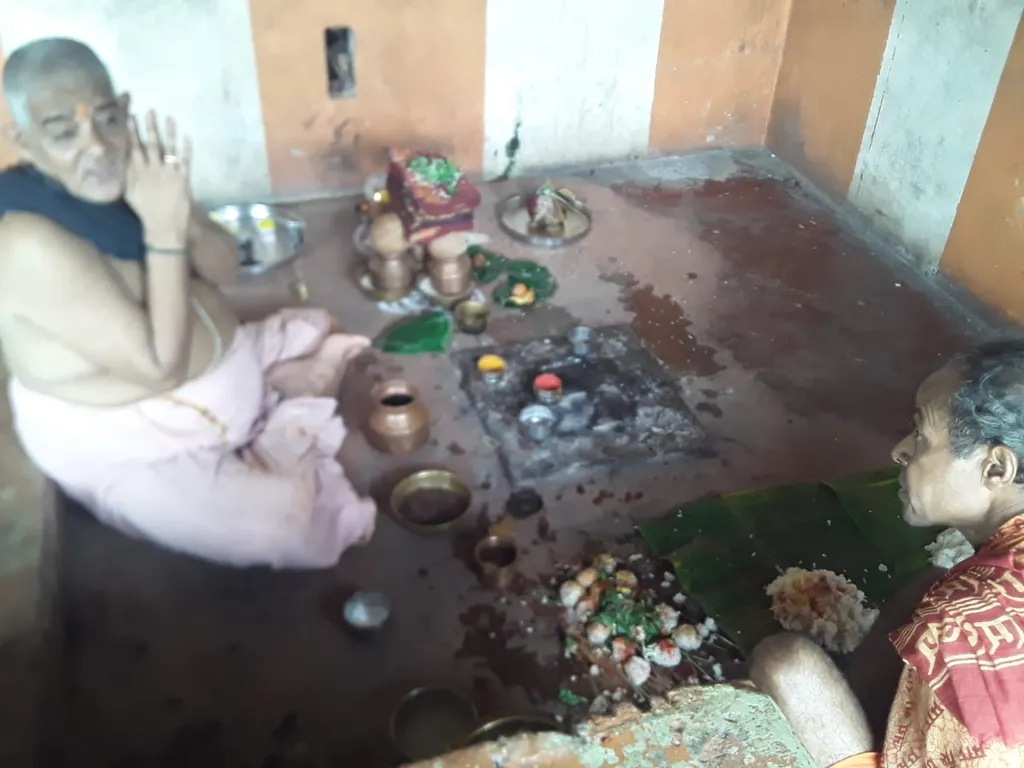
What is Tripindi Shraddha?
Tripindi Shraddha is a Vedic pitru karya in which three pindas are offered in one ceremony to settle what the shastras call the pitru rina — the debt every household owes the generations that came before it. Ordinary shraddha is an annual duty, performed on the tithi on which a parent or grandparent died, and a family that keeps it up has no need of this puja at all. Tripindi Shradh exists for the household where that annual duty stopped: because the family migrated, because the elders who knew the vidhi passed away, because nobody was in a position to travel to a kshetra, or simply because a generation lost the habit.
According to the shastras, ancestors who have not received their shraddha are held to remain unsettled rather than take their place among the pitrus, and the difficulty that is traditionally said to follow in the family is described as preta dosha or, in its wider astrological sense, pitru dosha (pitra dosh). Tripindi Shraddha is the rite prescribed to close that gap in one observance instead of attempting to make up decades of missed annual shraddhas one by one.
Call +91 83109 37047 (Vishu Guruling) for all Gokarna pooja details
WhatsApp UsWhat do the three pindas in Tripindi Shraddha represent?
The name is literal. Tri is three and pindi is the pinda — the ball of cooked rice mixed with sesame (til) and barley flour that is offered to the departed in every shraddha and in pind daan. Where an ordinary shraddha offers pindas to a named line of ancestors, Tripindi Shraddha offers three, so that no branch of the family is left out:
- The paternal line — father, grandfather and great-grandfather, and by extension every departed member of the karta's own gotra.
- The maternal line — mother, maternal grandfather and great-grandfather, the ancestors whom a household is most likely to have neglected because they belong to a different gotra.
- One's own line — the departed of the immediate family for whom nobody performed the rites: relatives who died childless or unmarried, infants, those who died away from home, and those whose pinda daan was never completed.
Traditional explanations also read the three pindas as being offered through Brahma, Vishnu and Rudra, corresponding to the three states in which unsatisfied ancestors are described as remaining. Both explanations are current among purohits, and neither changes the vidhi at the altar.
Who should perform Tripindi Shradh, and what prompts it?
The plainest trigger is a lapse. Where the annual shraddha, tarpan and pind daan have not been performed for several years — three years or more is the yardstick most commonly applied — Tripindi Shraddha is the rite the shastras prescribe to make good the omission. Families also come to Gokarna after an astrologer has read pitru dosha in a horoscope, after a death in which the antyeshti or the ten-day rites could not be completed properly, or when a household simply discovers that no one now living knows when the last shraddha was performed.
We should be honest about what a ritual is and is not. Devotees perform Tripindi Shraddha seeking peace for their ancestors and the relief of a dosha that is traditionally held to burden a lineage — that is the language the shastras use, and it is the language we use too. It is an act of duty and repayment, not a substitute for medical, legal or financial help, and no purohit should promise you an outcome in exchange for a puja.
Which three generations of ancestors does Tripindi Shraddha cover?
Shraddha in the Vedic system is offered to three ascending generations — pita, pitamaha and prapitamaha on the father's side, and the corresponding three on the mother's side — with the generations above them received into the collective body of the pitrus. Tripindi Shraddh keeps that structure and widens it. Alongside the named three generations of each line, the sankalpa includes the unnamed departed of the family: those whose names have been forgotten, those who died without issue, and those to whom no descendant is now offering water.
This is why the purohit will ask for the gotra of the family and the names and relationships of the ancestors you can remember. Nothing is lost if some names are unknown — the sankalpa has a form for exactly that case — but the names you do bring are read out individually during the tarpana and the pinda pradana.
Who is eligible, and what if there is no son in the family?
By long custom the karta is a son; where there are several sons, the eldest performs the Tripindi Shraddha puja and the rest participate. A married karta normally sits with his wife beside him. Where there is no son, the tradition allows a grandson, a brother, a nephew or another male of the same gotra to take the sankalpa, and in many families a daughter or a daughter's son performs it. The shastras themselves record more than one view here, and practice differs from region to region.
Our position is practical: tell us who is available before the date is fixed, and the sankalpa will be framed for your family's situation rather than turning anyone away at the altar. Families settled abroad who genuinely cannot travel should call and discuss what can be performed on their behalf — this is a conversation to have honestly in advance, not an assumption to make.
Is Tripindi Shraddha performed once in a lifetime or repeated?
It is a corrective ceremony rather than a calendar observance, and it is normally performed once. What matters is what happens afterwards: Tripindi Shradh does not replace the annual shraddha, the Mahalaya tarpana or the pind daan owed on the death tithi, and the whole point of performing it is that the family resumes those duties from the following year. If a household lapses again for a long stretch, or if a later generation finds the rites were once more left undone, Tripindi Shraddha may be performed a second time.
How many days does Tripindi Shraddha take at Gokarna?
The ceremony itself runs about three to four hours and is completed in a single day. Most families nevertheless plan two nights in Gokarna. The day of arrival is used for the teertha snana and the Kshetra Vidhi that precedes a major pitru karya, the Tripindi Shraddha is performed the next morning after the snana at Koti Teertha, and the pinda pradana and brahmana bhojana are finished within the same day. In practice the puja is arranged to begin in the morning so that nothing spills past the prescribed portion of the day; the exact start time is fixed against the panchanga for your date, and the purohit will tell you which darshan falls on which day of your stay.
Tripindi Shraddha at a glance
- Duration
- 1 day (approx. 3–4 hours)
- Best days & tithis
- Amavasya, Pitru Paksha, Trayodashi
- Who performs it
- Son, grandson or a family member of the lineage
- What we arrange
- Three-pinda samagri, priests, brahmana bhojana
- Where
- Shree Mahabaleshwar Temple compound and Koti Teertha, Gokarna, Uttara Kannada, Karnataka
Tripindi Shraddha vidhi: the procedure step by step
- Snana and preparation: The karta bathes at Koti Teertha or at the sea, and the purohit prepares the altar and the offerings for the day's puja.
- Sankalpa: The karta states his name, gotra and intention, and names the ancestors of the paternal line, the maternal line and his own line for whom the Tripindi Shraddha is being performed.
- Invocation: The priest invokes the blessings of Lord Shiva and invites the souls of the ancestors to accept the offerings.
- Tarpana: Water mixed with til and darbha is offered to each generation named — the tarpan that opens every shraddha, South and North alike.
- Tri-pinda pradana: Three pindas prepared from rice, sesame seeds and barley flour are offered, representing the ancestors of three generations — paternal, maternal and one's own.
- Mantras and homa: Sacred mantras purify the offerings, and the oblations are made into the holy fire, which is regarded as the agent that carries what is offered to the ancestors.
- Brahmana bhojana and daana: Brahmins are fed and donations are made to the priests and to the poor, seeking the blessings of the ancestors.
- Completion: The ritual concludes with a final prayer expressing gratitude to the ancestors for their guidance and blessings.
Families who wish to strengthen the observance often add a Thila Homam (Tila Havana) on the same visit, since the sesame offering is the element common to every pitru rite.
On which tithi and days is Tripindi Shradh performed?
Amavasya, the sixteen days of Pitru Paksha and Trayodashi are the days most often chosen. Mahalaya Amavasya and Sarva Pitru Amavasya, which fall at the close of the Pitru Paksha fortnight, are the single busiest days of the Gokarna year for ancestral rites, and dates in that window are taken well in advance — our Pitru Paksha shraddha, tarpan and pind daan services page sets out what is performed during those days. Outside that fortnight, an Amavasya in any month is suitable. If your travel dates are fixed and fall elsewhere in the calendar, the purohit reads the panchanga and gives you the nearest appropriate day rather than pushing you into an inauspicious one.
What does Tripindi Shraddha cost at Gokarna, and what is included?
No figure is printed on this page, and you should be wary of any that is quoted without knowing your family's details. The dakshina for a Tripindi Shraddh is settled once the purohit knows how many pindas the sankalpa requires, how many priests will officiate, whether the rite is performed on its own or alongside another pooja, and how many people will be present for the brahmana bhojana. Arranged for you as standard: the three-pinda samagri, the priests and the brahmana bhojana. Read our Gokarna pooja cost guide for how a quotation is built up, then call +91 83109 37047 or +91 88613 21496 and you will be told the exact amount before you travel.
What samagri is needed, and what should the family bring?
All ritual material is arranged here, so nothing needs to be bought or carried from home. What you must bring is information: the names and gotra of the ancestors being remembered and each one's relationship to the karta. Also carry traditional dress for the ceremony — a dhoti for the karta, a saree or salwar for the women of the family — and a change of clothes for the teertha snana. Families observing the older discipline take a simple satvik meal without onion and garlic on the day, and eat only after the brahmana bhojana is complete. Tell us in advance if anyone in the party is elderly or unwell, so the seating and sequence can be adjusted.
Why perform Tripindi Shraddha at Gokarna?
Gokarna's standing as a place of pitru karya rests on the Atmalinga installed at Shree Mahabaleshwar Temple and on the town's position where the Aghanashini and Gangavali meet the Arabian Sea — a confluence of river and ocean that Hindu tradition holds to be among the most auspicious settings for shraddha, tarpana and pinda offerings. The Koti Teertha tank supplies the snana that opens the rite, and the sea the visarjan that closes it. Devotees have long spoken of Gokarna as a Dakshina Kashi and a mukti kshetra. If you are visiting for the first time, our notes on Gokarna town and on the beach and the teerthas will help you plan the days around the puja.
One practical point worth stating: this is Gokarna in Uttara Kannada district, Karnataka, on the Konkan coast — not Gokarna in Nepal, and not the Mahabaleshwar hill station in Maharashtra. Gokarna Road on the Konkan Railway is the nearest station, Kumta and Ankola are the nearest towns on the highway, and Goa and Hubballi are the closest airports.
Can Tripindi Shraddha be combined with Narayana Bali or Naga Bali?
It can, and families travelling a long distance usually do combine rites rather than make two journeys. Moksha Narayana Bali Pooja is performed for a departed soul that has not attained gati; Naga Bali (Nagbali puja) addresses sarpa dosha; Narayan Nagbali is the two rites performed together; and pind daan at Koti Teertha can be added for a specific departed relative. Tripindi Shraddha sits naturally alongside any of them, but each rite has its own day and its own vidhi — combining them lengthens the visit rather than the morning. Say at the time of booking which poojas you intend, and the whole sequence will be scheduled around your travel dates.
How to book Tripindi Shraddha puja at Gokarna
Call Vishweshwar D. Bhat Gurulingaji, Kshetra Gokarna Purohit, on +91 83109 37047 or +91 88613 21496, send a message on WhatsApp, or use the enquiry form. You can also read how online pooja booking at Gokarna works, or see the full range of rites on our pooja services page. Have three things ready when you call: the names and gotra of the ancestors, the dates you can travel, and the number of people coming with you. The date is confirmed against the panchanga, and the arrangements — priests, samagri, brahmana bhojana and guidance on where to stay — are made from this end.
Related poojas at Gokarna
Tripindi Shraddha — frequently asked questions
What is the cost of Tripindi Shraddha at Gokarna?
How long does Tripindi Shraddha take — one day or three days?
Who should perform Tripindi Shraddh in the family?
Can a daughter or a married woman perform Tripindi Shraddha?
On which tithi is Tripindi Shraddha performed?
Is Tripindi Shraddha performed only once, or every year?
Can Tripindi Shraddha and Narayana Bali be performed on the same trip?
What samagri do I need to bring for Tripindi Shraddha?
Is Tripindi Shraddha better performed at Gokarna or Trimbakeshwar?
Perform Tripindi Shraddha at Gokarna
Speak to Vishweshwar D. Bhat Gurulingaji for auspicious dates, the vidhi procedure and complete arrangements for your visit.